Revise Blog - Building a post-AI word processor
The best Google Docs alternatives in 2026
Seven word processors compared on price, AI editing, page layout, and how well they handle your Word files
 Artur Sapek, Founder of Revise9 min read
Google Docs remains a useful collaborative word processor, and Gemini can now propose edits directly in the document. If you are considering a switch, compare the review workflow, Word compatibility, model access, and hosting requirements that matter to you. These seven alternatives serve different needs. See Google’s editing guidance.
I have spent the past year building a word processor from scratch, so I have used every tool on this list closely, including how each one handles real .docx files and long documents. Prices and plans come from each vendor’s own pages, linked in the sources at the end.
Google Docs alternatives at a glance
Start with the row that matches your reason for leaving. “AI capabilities” is the column that differs most: some tools revise a whole document, some work on selections, one has no built-in AI, and only a few show AI edits as suggestions you can accept or reject.
| Tool | Best for | Free plan | Paid from | AI capabilities |
|---|---|---|---|---|
| Revise | Word-grade documents and reviewable AI editing in the browser | Yes (daily AI limit) | $8/mo (Plus) | Agent proposes text and formatting edits as suggestions. Header, footer, and page-layout changes apply directly |
| Microsoft Word | Teams standardized on Microsoft 365 | Yes (Word for the web) | $9.99/mo (Microsoft 365 Personal) | Copilot drafts, rewrites, and summarizes, edits in place with highlight and undo |
| Zoho Writer | A like-for-like Google Docs swap | Yes (all editing features, extra automation credits paid) | Free | Zia drafts, rewrites, and summarizes selected content or the whole document |
| Notion | Team wikis and linked notes | Yes (AI as a trial) | $10/mo (Plus) | Searches the workspace, answers questions, writes and rewrites blocks |
| OnlyOffice | Self-hosting with strong Word fidelity | Yes (desktop apps, self-hosted, and DocSpace Startup cloud) | $20/mo (DocSpace Business (cloud, per admin)) | Inline agent edits and formats with conversation history, broader agent features depend on edition and setup |
| LibreOffice Writer | Free, private desktop writing | Yes (free and open source) | Free | None built in |
| Apple Pages | Mac, iPhone, and iPad users | Yes (free on Apple devices) | $12.99/mo (Apple Creator Studio (optional)) | Proofreads, rewrites, and summarizes selected text |
The basics differ less than you might expect. Most keep real-time co-editing and paginated page layout; Notion is the exception on layout, and LibreOffice on co-editing.
| Tool | Real-time co-editing | .docx | Page layout | Open source |
|---|---|---|---|---|
| Revise | Yes | Yes (import and export) | Yes | No |
| Microsoft Word | Yes | Yes (native format) | Yes | No |
| Zoho Writer | Yes | Yes (import and export) | Yes | No |
| Notion | Yes | Partial (import only) | No (pages scroll, no print layout) | No |
| OnlyOffice | Yes | Yes (native OOXML) | Yes | Yes |
| LibreOffice Writer | - | Yes (import and export) | Yes | Yes |
| Apple Pages | Yes (via iCloud) | Yes (import and export) | Yes | No |
The quickest way to test the top pick: copy your Google Doc and paste it below, or import the .docx. It opens in Revise in your browser, and your first AI request needs no account.
How we evaluated them
Google Docs sets the baseline: free, browser-based, real-time co-editing, comments and suggestions, and version history. Each alternative was judged on whether it keeps that baseline and what it adds. Six checks:
- Your files: does a real
.docxkeep its sections, headers and footers, footnotes, numbering, tracked changes, and comments through import and export? - Collaboration: can two people edit the same document at once, and can you share a link?
- AI you can review: can the AI work across the whole document, and can you see and reject what it changed?
- Price: what one person pays per year for the plan that includes the features above.
- Privacy and control: where documents live, and whether you can self-host.
- Switching cost: how long it takes to move an existing Google Drive folder over.
The ranking weighs Word compatibility, AI editing, and collaboration most heavily, because those are the reasons most people give for switching in 2026. If your reason is different, the fit table further down is a better guide than the order of the list.
The 7 best Google Docs alternatives
1. Revise: Best for Word-grade documents with AI you can review
- Free plan: Yes, daily AI limit
- Paid from: $8/mo
- Built-in AI: Revise Agent
Revise is an online document editor with the Google Docs basics: real-time co-editing, share links, comments, and version history. Its revision history shows what changed as a red and green diff rather than a list of timestamps.
Revise supports many Word features, including section layouts, headers and footers, footnotes, legal numbering, tracked changes, and comments. Some features are retained for export without being fully displayed, and others can change when edited. Inspect your document and see the Word compatibility reference .
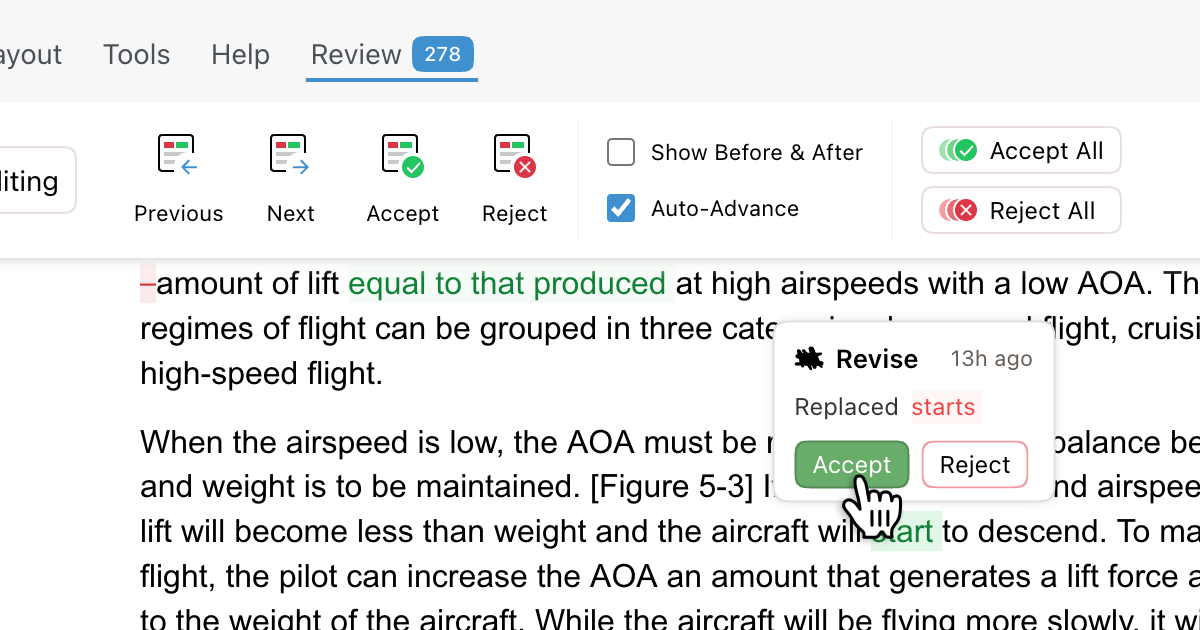
Revise’s AI agent proposes text and formatting edits as tracked changes you accept or reject. Header, footer, and page-layout changes apply directly. Revise’s Free plan includes a daily AI allowance with GPT-6 Luna; paid plans add more models and usage. See the supported models . Its MCP server also lets Claude or ChatGPT work on Revise documents, subject to connection limits.
Pick it if your documents are headed for Word, print, or a filing, or you want AI to do real editing work with text and formatting changes reviewable. Skip it if you depend on deep ties to Gmail and Google Drive.
2. Microsoft Word: Best for Microsoft 365 teams
- Free plan: Yes, Word for the web
- Paid from: $9.99/mo
- Built-in AI: Copilot
Microsoft Word is the native home of the .docx format, and its desktop apps have the deepest feature set of any word processor: style editing, mail merge, fields, and embedded objects. Word for the web is free with a Microsoft account; the desktop apps come with a Microsoft 365 subscription.
Copilot can draft, revise, and summarize inside Word. Access depends on the Microsoft 365 plan, platform, and organization settings. Personal and Family subscriptions include AI features with usage limits, and the AI benefits belong to the subscription owner. Microsoft also documents a Word model selector with providers including OpenAI and Claude; availability can depend on licensing and administrator settings.
Pick it if your organization already runs on Microsoft 365, or you need mail merge and style editing. Skip it if you want a browser-first editor or do not want a subscription.
3. Zoho Writer: Best like-for-like Google Docs swap
- Free plan: Yes, editing is free
- Paid from: Free
- Built-in AI: Zia
Zoho Writer is the closest thing to Google Docs without Google: a clean online word processor with real-time co-editing, comments, good .docx handling, and a generous free plan. It has fewer third-party integrations than Google’s ecosystem.
Zia supports drafting, rewriting, and summarizing selected content or a whole document. Zoho offers its own generative AI and an optional OpenAI connection. Check how its review controls fit your process rather than assuming it is limited to individual sentences.
Pick it if you want Docs minus Google with the least relearning. Skip it if AI editing is your main reason to switch.
4. Notion: Best for team wikis
- Free plan: Yes, AI trial
- Paid from: $10/mo
- Built-in AI: Notion AI
Notion is a block-based workspace where pages, wikis, and databases live together. It beats Google Docs for linked team knowledge and loses to it on anything you need to format, print, or export cleanly.
Notion AI can search workspace content and help create or edit pages and databases. It is available on Business and Enterprise plans, with limited trial responses on Free and Plus. Some features use allowances or credits. Inline edits can be accepted or discarded, but a page-editing workflow should be evaluated separately from native Word tracked-change interoperability.
Pick it if your “documents” are really a team wiki. Skip it if you send .docx files to other people.
5. OnlyOffice: Best for self-hosting
- Free plan: Yes, desktop, self-hosted, and cloud
- Paid from: $20/mo
- Built-in AI: AI plugin (OpenAI, Anthropic, Gemini, local models)
OnlyOffice is an open-source office suite with strong Microsoft-format fidelity and real-time co-editing. You can run it on your own server, which is the main reason to choose it.
ONLYOFFICE supports multiple AI providers and local-model setups. Its current AI tools include an inline agent for editing and formatting, with conversation history, plus broader agent features. Setup and availability vary by edition and configuration. For a team evaluating it, test the exact editing and review workflow rather than assuming the AI only returns text.
Pick it if documents must stay on your own infrastructure. Skip it if you do not want to run a server.
6. LibreOffice Writer: Best free desktop option
- Free plan: Free and open source
- Paid from: Free
- Built-in AI: None
LibreOffice Writer is free, open-source desktop software for Windows, Mac, and Linux. It handles .docx well, needs no account, and your files never leave your machine.
There is no real-time co-editing and no built-in AI. The project describes itself as having “no forced AI,” which for some writers is the point.
Pick it if you write alone and want no account and no cloud. Skip it if you collaborate on documents every day.
7. Apple Pages: Best for Apple devices
- Free plan: Yes, on Apple devices
- Paid from: $12.99/mo
- Built-in AI: Apple Intelligence Writing Tools
Pages is free on Mac, iPhone, and iPad, with polished templates and real-time collaboration through iCloud. It opens and exports .docx, though complex Word layouts do not always survive the round trip. An optional Apple Creator Studio subscription adds premium templates and image tools.
On devices that support Apple Intelligence, the system-wide Writing Tools can proofread, rewrite, and summarize selected text.
Pick it if everyone you work with uses Apple devices. Skip it if collaborators are on Windows or Android.
Which alternative fits your job?
Revise is the first stop for Word-grade documents and AI-assisted editing in the browser. Word fits organizations already on Microsoft 365. Zoho Writer is the smallest change from Google Docs. Notion fits team knowledge bases. OnlyOffice fits teams that must self-host. LibreOffice is the free desktop pick, and Pages is the natural choice on Apple devices.
| Why you are leaving | Best fit | When Google Docs still wins |
|---|---|---|
| AI that edits the whole document | Revise | Gemini’s document editing fits your workflow and you have eligible Workspace or Google AI access. |
| Word files with real layout: sections, footnotes, legal numbering | Revise | The document is a simple draft that never leaves the browser. |
| Organization standardized on Microsoft 365 | Microsoft Word | Your team lives in Gmail, Drive, and Meet. |
| Leaving Google, same workflow | Zoho Writer | You rely on Google Workspace integrations. |
| Team wiki and linked notes | Notion | You need clean exports and page layout. |
| Documents on your own servers | OnlyOffice | Compliance does not require self-hosting. |
| Free desktop app, files stay local | LibreOffice Writer | You co-edit with other people every day. |
| Everyone uses Apple devices | Apple Pages | Collaborators are on Windows or Android. |
What Google Docs still does best
Before you switch, be clear about what you would give up.
- Zero-friction sharing. Almost everyone has a Google account, so a Docs link opens for anyone without an invite or a signup.
- Workspace integration. Docs, Gmail, Drive, Calendar, and Meet share one account, one permission model, and one search.
- Mature co-editing at scale. Dozens of people can edit one document at once, and comment and suggestion workflows are familiar to everyone.
- Price. Personal use is free, with generous storage.
For many people the practical setup is Google Docs for quick shared notes plus one specialist tool for the documents that matter: Revise for Word-grade documents and AI-assisted revision, Word for Microsoft 365 workflows, or LibreOffice for private desktop work.
What each alternative costs
All seven have a usable free option; Zoho Writer and LibreOffice are free outright. The cheapest paid plans differ mostly in how much AI they include, and for comparison, Google Docs’ own AI needs Workspace Business Standard ($14 per user per month) or Google AI Pro ($19.99 per month).
| Tool | Cheapest paid plan | Monthly | Per year | AI on that plan |
|---|---|---|---|---|
| Revise | Plus (or $72/yr billed annually) | $8/mo | $72 | Monthly AI limit, no daily limit. GPT-6 Sol, GPT-6 Astra, and Claude Opus 5.5 need Pro |
| Microsoft Word | Microsoft 365 Personal | $9.99/mo | $99.99 | Eligible Microsoft 365 plans, with limits. Personal/Family AI benefits are for the owner |
| Zoho Writer | None for editing (WorkDrive team plans, automation credits) | Free | Free | Zia, on Zoho's model or your own OpenAI key |
| Notion | Plus (per seat, billed yearly ($12 monthly)) | $10/mo | $120 | Limited trial on Free/Plus. Business and Enterprise include AI with feature allowances |
| OnlyOffice | DocSpace Business (cloud, per admin) (per admin, promotional (normally $30)) | $20/mo | - | Plugin, connect your own provider |
| LibreOffice Writer | None, completely free | Free | Free | None built in |
| Apple Pages | Apple Creator Studio (optional) | $12.99/mo | $129 | Creator Studio adds image tools, Writing Tools are free on supported devices |
How to switch from Google Docs
Export a copy from Google Docs as Microsoft Word (.docx), then import it into the editor you want to try. Before migrating a working document, check its headings, comments, suggestions, tables, and page layout in the imported file and in an exported Word copy. Keep the original while you compare the result.
- Export one document: in Google Docs, open File → Download → Microsoft Word (.docx).
- Export a whole folder: use Google Takeout, choose Drive, and set the Docs format to
.docx. - Import: open the file in the new tool. In Revise, drop it into the editor above and inspect the document’s layout and review features.
- Check the tricky parts: page breaks, headers and footers, and numbered lists are where format conversions most often slip.
The bottom line
If your organization runs on Microsoft 365, use Word. If your documents are really a team wiki, use Notion. If you must self-host, use OnlyOffice. If you want free desktop software, use LibreOffice. If you want Google Docs minus Google, Zoho Writer is the closest match.
If you want Word-style page layout in the browser, with AI edits you review as tracked changes, Revise fits. For more on AI editing, see how to use Claude with Google Docs and which AI model proofreads best.
Sources
Prices and plan details were checked against each vendor’s own pages on October 4, 2026. Prices are in US dollars as each vendor lists them, and some include local tax. Vendors change plans often, so confirm on the linked page before you buy.
- Revise: Pricing, Supported models, Agent capabilities, Word compatibility, Import and export, MCP server, Suggesting mode, AI usage limits
- Microsoft Word: AI capabilities and access, Previous versions, Track Changes, Navigation pane, Real-time co-authoring, Save as PDF, Compare documents (legal blackline), Microsoft 365 plans, Word for the web, Revise's AI review test, Copilot in Word, Track Changes in Word for the web, Word options: General, Print a document, Office for the web in OneDrive, Microsoft 365 mobile apps, Removed Windows features (WordPad), Word for the web service description, Similarity checking, Editing with Copilot and Track Changes (Microsoft 365 Copilot), Copilot and document length, When you need a Microsoft 365 subscription
- Zoho Writer: AI capabilities and access, Writer pricing, WorkDrive pricing
- Notion: AI capabilities and access, Export your content, Pricing, Working offline
- OnlyOffice: AI capabilities and access, Compare editions, Document editor, DocSpace pricing, AI assistants, Desktop editors
- LibreOffice Writer: Writer guide: advanced text, Writer guide, LibreOffice 26.8 release, Download, Track changes, LibreOffice, System requirements, Using Microsoft Office files
- Apple Pages: App Store listing, Collaborate in Pages, Word files in Pages, Pages, Creator Studio in Pages, Writing Tools