Revise Blog - Building a post-AI word processor
Grammarly vs ProWritingAid for writing
Two grammar checkers built for different writers, compared on price, languages, reach, and what their AI adds
 Artur Sapek, Founder of Revise7 min read
Both tools underline problems as you write and add AI rewrites on top, so they can look like the same product. The difference is in what each one focuses on. Grammarly focuses on help across apps, tone, and detection, and ProWritingAid focuses on reports and tools for long English manuscripts.
I have spent the past year building Revise, a word processor with an AI editing agent, which is mentioned briefly near the end. That work involves studying how writing tools check and change text. The plans and limits below come from each vendor’s own pages, which are linked in the sources at the end.
Grammarly vs ProWritingAid at a glance
| Grammarly | ProWritingAid | |
|---|---|---|
| Free plan | Yes (100 AI prompts a month) | Yes (suggestions for 500 words at a time, 10 Rephrases a day) |
| Paid from | $12/mo (Pro) | $10/mo (Premium) |
| Lifetime license | None listed | $399 Premium, $699 Premium Pro |
| Languages | 23 for spelling and basic grammar, 6 for advanced suggestions | English only (US, UK, AU, CA) |
| AI capabilities | Grammar, tone, and sentence rewrites as inline suggestions, AI detection | Grammar, style, and line-editing reports, Rephrase, Chapter Critique, paid manuscript analysis |
| Free-plan limits | 100 AI prompts a month | 500 words at a time, 2 runs of each line-editing report and 10 Rephrases a day |
| Inside Word | Yes (via the Grammarly desktop app) | Yes (add-in for Word 2016 and later on Windows, browser extension for Word on the web) |
| Trial or refund window | 7-day Pro trial shown on the plans page | Free plan, paid yearly and lifetime purchases have a 3-day money-back guarantee |
For a whole-document proofread to compare against either checker, paste a draft below and ask the agent to proofread it. It opens in Revise in your browser. You can make one request without an account, and you need a free account to accept changes.
Key differences
These are the differences that matter most when choosing between them.
Who each is built for
ProWritingAid is aimed at novelists. Its free plan includes Story Canvas, Sparks, and Creative Nudges, Premium adds a daily Chapter Critique, and paid Story Credits buy manuscript, plot, and character analysis, a virtual beta reader, and a marketability analysis. Grammarly’s extras are aimed at work and school: tone detection, plagiarism and AI-text detection on Pro, one style guide and one brand tone on Pro (unlimited on Enterprise), and Grammarly Docs agents such as AI Grader, Citation Finder, and Reader Reactions.
Edge: ProWritingAid is better for fiction, and Grammarly is better for work and school writing.
Grammar and style checking
Both check grammar, spelling, and style as you type. ProWritingAid adds more than 25 reports on Premium and unlimited line-editing runs, and the free plan allows two runs of each line-editing report a day. Grammarly’s free plan corrects spelling and grammar without a cap, and its advanced clarity, fluency, and tone suggestions are limited to three accepted suggestions a day. Pro gives full access to those suggestions and to full-sentence rewrites. The vendor pages we reviewed give no comparable, reproducible accuracy results, and neither app is included in ErrataBench, which tests AI models rather than apps, so this comparison cannot name an accuracy winner.
Edge: we have no evidence to name a winner on accuracy, but ProWritingAid documents a deeper set of reports.
Languages
Grammarly corrects spelling and basic grammar for free in 23 languages and offers advanced suggestions and paragraph rewrites in English, Spanish, French, German, Portuguese, and Italian (Grammarly languages). ProWritingAid checks English only, in US, UK, Australian, and Canadian variants.
Edge: Grammarly, because it supports more languages.
Where each works
Grammarly runs through desktop apps for Windows and Mac, extensions for Chrome, Safari, Firefox, and Edge, and apps for iPhone, iPad, and Android, and it works in Word and Google Docs (Grammarly for desktop). ProWritingAid has a web editor, Windows and macOS apps, a Word add-in for Windows (Word on the web works through its browser extension), Google Docs, Scrivener, and Chrome, Firefox, and Edge extensions.
Edge: Grammarly works in more places, including Safari and mobile, but ProWritingAid is the better choice if you draft in Scrivener.
Price
ProWritingAid Premium is $10 a month billed yearly ($120) or $30 month to month, and Premium Pro is $12 a month billed yearly. A lifetime license costs $399 for Premium or $699 for Premium Pro. Grammarly Pro is $12 a month billed annually ($144) or $30 month to month, with no lifetime option.
Edge: ProWritingAid, because it is cheaper on a yearly plan and offers a one-time license.
Which should you choose?
Choose Grammarly if
- you write in several apps a day, including on your phone
- you write in a language other than English
- you want plagiarism and AI-text detection in the same plan
- you want a style guide and brand tone applied to your suggestions
Choose ProWritingAid if
- you are writing a novel or other long manuscript
- you draft in Scrivener
- you prefer paying once to a subscription
- you want detailed style reports rather than quick fixes
What each costs
| Tool | Cheapest paid plan | Monthly | Per year | AI on that plan |
|---|---|---|---|---|
| Grammarly | Pro (billed annually, $30 month to month) | $12/mo | $144 | 2,000 AI prompts a month |
| ProWritingAid | Premium (billed yearly ($120), $30 month to month) | $10/mo | $120 | Unlimited Rephrases, 1 Chapter Critique and 5 Sparks a day |
Where Revise fits
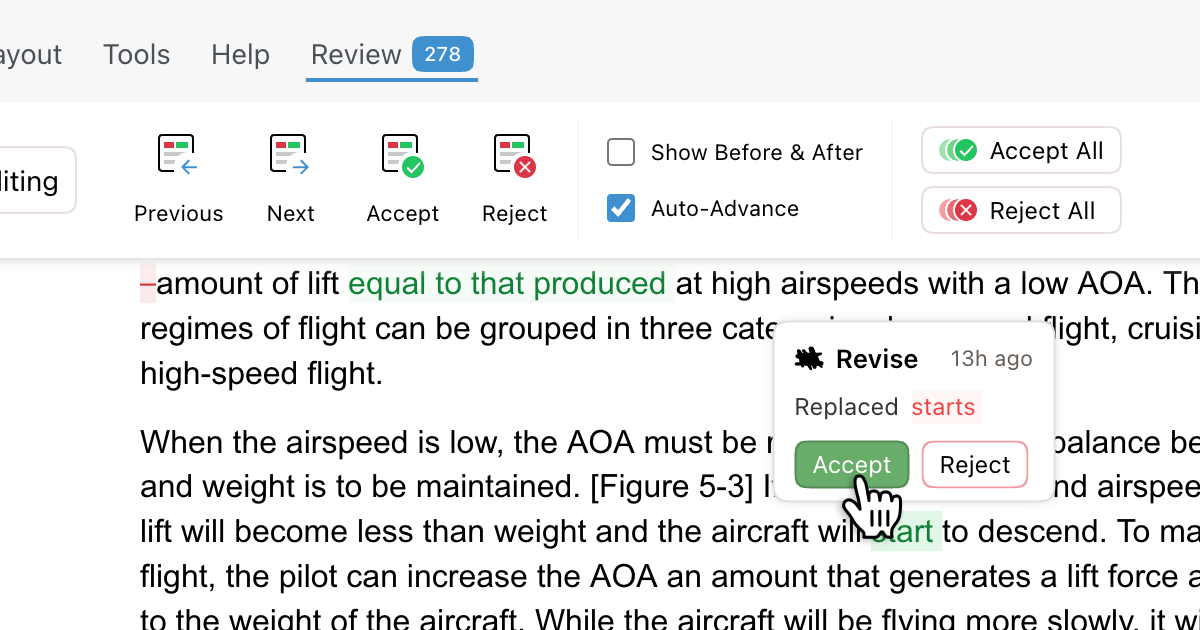
Revise, which publishes this guide, is a browser word processor whose AI agent proofreads a whole document on request and proposes text and formatting fixes as tracked changes, using models such as GPT and Claude. It opens and exports Word files. It is a separate editor, so it does not check your writing inside other apps as you type.
The bottom line
If you write English fiction and want to pay once, choose ProWritingAid. If you write across apps, devices, or languages, choose Grammarly.
Sources
Prices and plan details were checked against each vendor’s own pages on October 4, 2026. Prices are in US dollars as each vendor lists them, and some include local tax. Vendors change plans often, so confirm on the linked page before you buy.
- Grammarly: Usage and document limits, Languages, Desktop app, Browser extension, Grammarly Docs, Plans, Grammarly for Word
- ProWritingAid: Pricing, System requirements, Word for the web, Home page