Revise Blog - Building a post-AI word processor
Scrivener vs Word for writing a book
How the two compare on organizing a long draft, review tools, producing the finished book, AI, and price
 Artur Sapek, Founder of Revise7 min read
Writers compare these two because they treat a book in different ways. Scrivener organizes a manuscript as a project and compiles it to formats such as .docx, PDF, and ePub. Word edits the manuscript directly as a Word document, which is the same file an editor or co-author opens.
I have spent the past year building a word processor that has to handle book-length Word files, so I pay close attention to how both handle a long manuscript. Prices and features below come from Literature & Latte’s and Microsoft’s own pages, linked in the sources.
Scrivener vs Word at a glance
| Scrivener | Microsoft Word | |
|---|---|---|
| Free plan | No (30-day trial on Mac and Windows, counted in days of use) | Yes (Word for the web) |
| Paid from | $59.99 one-time (Scrivener 3 for macOS or Windows) | $9.99/mo (Microsoft 365 Personal) |
| Platforms | Mac, Windows, iPhone, iPad | Web, Windows, Mac, iOS, Android |
| Organizing a long draft | Binder, corkboard, outliner, and Scrivenings | Heading styles, Navigation pane to jump, and reorder on Windows |
| Review tools | Comments and annotations | Track Changes and comments |
| Real-time co-editing | - | Yes |
| Finished output | Compiles to Word, PDF, ePub, Kindle, Final Draft, and more | .docx natively, saves as PDF |
| AI capabilities | No AI features on the vendor's pages | Copilot drafts, rewrites, and summarizes, edits in place with highlight and undo |
| Offline | Yes | Yes (desktop apps) |
If your manuscript is a Word file, or you compile one from Scrivener, paste a chapter or import the .docx below and ask for an AI revision. It opens in Revise in your browser, where you can try one AI request without an account. You need a free account to accept a suggested change.
Key differences for writing a book
These are the five differences that matter most for a book. Each one ends with a note on which app has the edge.
Organizing a long draft
In Scrivener each scene or chapter is its own document in a binder. You rearrange them by dragging index cards on a corkboard or rows in an outliner, tag them with labels, status, and keywords, and read any selection as one continuous text in Scrivenings mode. Research such as PDFs, images, and web pages sits in the same project and can open beside the draft in a split editor. Scrivener also has snapshots, word targets, and a writing history.
Word keeps the book in one file. On Windows, the Navigation pane lists your headings, jumps to any chapter, and moves a whole section when you drag its heading. Microsoft notes that it works differently in Word for Mac and on the web.
Edge: Scrivener, because it keeps scene-level structure and research in one project.
Review with an editor or co-author
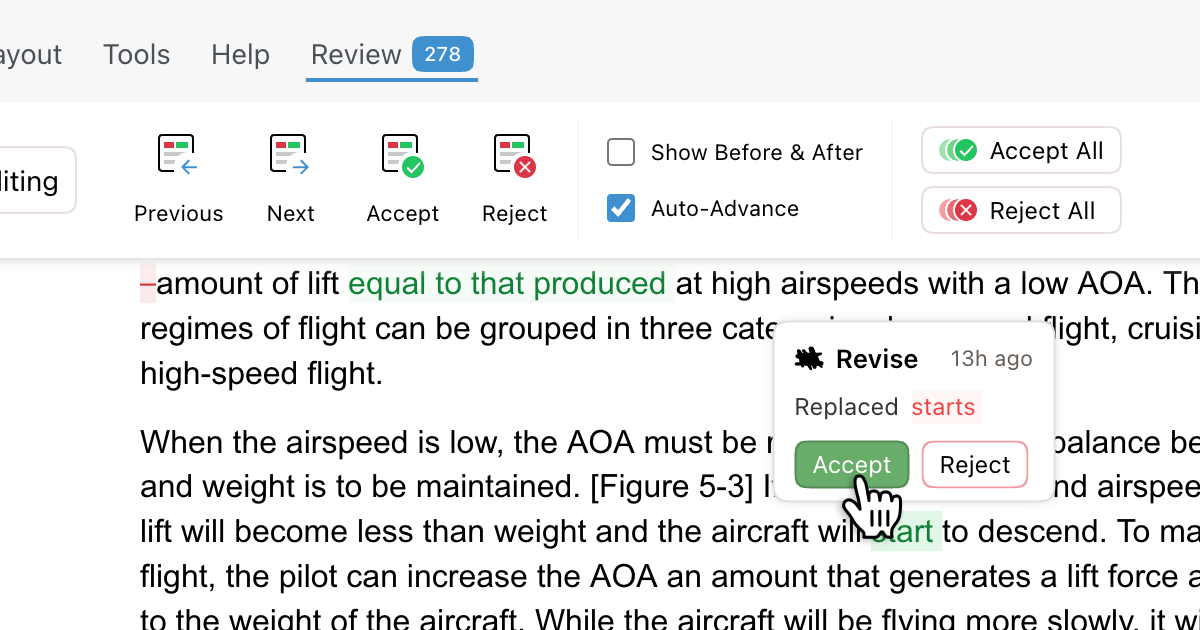
Word has Track Changes on desktop, web, and mobile, and real-time co-authoring in shared documents, so an editor can mark up the same .docx you write in. Scrivener documents in-project comments and annotations, and it can compile a .docx for someone else to review.
Edge: Word, because it documents a review workflow with tracked changes and real-time editing.
Producing the finished book
Scrivener’s Compile assembles the manuscript into Word, PDF, ePub and Kindle ebooks, Final Draft, plain text, or MultiMarkdown for LaTeX, so one project can produce a manuscript and an ebook. Word produces a .docx and can save as PDF. For ebooks, you can take the Word file to a formatter such as Vellum or Atticus, which both import .docx.
Edge: Scrivener if you need ebook files, and Word if the deliverable is a .docx.
AI
Scrivener does not document any built-in AI. Word has Copilot, which is included in Microsoft 365 Personal and, for the subscription owner only, Family, with usage limits. It can draft, rewrite, and summarize text. In our document review test, it edited text in place with a blue highlight and an undo button rather than as tracked changes. Add-ins also run inside Word. For example, Claude for Word (Claude Pro and up) works through comment threads and can make edits as tracked changes when Track Changes is on.
Edge: Word, if you want AI built into the app.
Price and platforms
Scrivener is a one-time purchase. It costs $59.99 for Mac or Windows, $23.99 for iOS, or $95.98 for a Mac and Windows bundle, and the 30-day trial on Mac and Windows counts only the days you use it. Major upgrades are paid. Word’s desktop apps come with Microsoft 365 Personal at $99.99 a year, which includes the rest of the Microsoft 365 apps. Word is also sold as a one-time purchase in Office Home 2024, which costs $179.99 for one PC or Mac (Microsoft 365 plans). Word for the web is free. Word also runs on Android and in a browser, and Scrivener does not.
Edge: Scrivener if you want the lower upfront price for a desktop license, and Word if you want free browser access and support for more devices.
Which should you choose?
Choose Scrivener if
- your book has many scenes, plotlines, or research notes
- you want to rearrange the draft scene by scene
- you want to compile ebooks from the same project
- you want a lower one-time price for a desktop app
Choose Word if
- you trade tracked changes with an editor
- you co-write in real time
- you want AI built into the app
- you need to work on Android or in a browser
Using both
You can use both. You can draft and restructure in Scrivener, compile to Word when a draft goes to an editor or beta readers, and compile the finished manuscript or ebook in Scrivener, or format the Word file in a dedicated formatter. Scrivener also imports Word documents, so an existing manuscript can move the other way.
What each costs
| Tool | Cheapest paid plan | Monthly | Per year | AI on that plan |
|---|---|---|---|---|
| Scrivener | Scrivener 3 for macOS or Windows (per platform, iOS $23.99, Mac + Windows bundle $95.98, major upgrades paid) | $59.99 one-time | - | None |
| Microsoft Word | Microsoft 365 Personal | $9.99/mo | $99.99 | Eligible Microsoft 365 plans, with limits. Personal/Family AI benefits are for the owner |
Where Revise fits
Revise, which publishes this guide, is a browser word processor that opens a .docx written in Word or compiled from Scrivener. Its AI agent proposes text and formatting edits as tracked changes, using a GPT, Claude, Gemini, or Grok model, and it exports back to Word. AI usage is limited by plan, and some models need a paid plan. It has no binder or ePub export, and it is a separate browser editor rather than part of Word.
The bottom line
Choose Scrivener if organizing and rearranging the manuscript is the hardest part of your project. Choose Word if you mostly need direct .docx editing, review with tracked changes, or co-authoring.
Sources
Prices and plan details were checked against each vendor’s own pages on October 4, 2026. Prices are in US dollars as each vendor lists them, and some include local tax. Vendors change plans often, so confirm on the linked page before you buy.
- Scrivener: Scrivener overview, Scrivener features, Store, FAQ
- Microsoft Word: AI capabilities and access, Previous versions, Track Changes, Navigation pane, Real-time co-authoring, Save as PDF, Compare documents (legal blackline), Microsoft 365 plans, Word for the web, Revise's AI review test, Copilot in Word, Track Changes in Word for the web, Word options: General, Print a document, Office for the web in OneDrive, Microsoft 365 mobile apps, Removed Windows features (WordPad), Word for the web service description, Similarity checking, Editing with Copilot and Track Changes (Microsoft 365 Copilot), Copilot and document length, When you need a Microsoft 365 subscription
- Vellum: Vellum, Vellum Press, Importing
- Atticus: Atticus, Checkout
- Claude for Word: Claude for Word, Pricing