Revise Blog - Building a post-AI word processor
Claude vs ChatGPT for writing
Proofreading accuracy, long documents, Word files, and price, compared on each vendor’s current plans and our own benchmark
 Artur Sapek, Founder of Revise7 min read
Claude and ChatGPT are two common choices for drafting, revising, and working with uploaded documents. It is more useful to ask which one fits the writing you do than which model is smarter in general. This comparison focuses on long drafts, careful edits, and Word files.
I have spent the past year building a word processor that runs both model families, and we benchmarked models from both companies on the same proofreading task. Plans and limits below come from each vendor’s own pages.
Claude vs ChatGPT at a glance
| ChatGPT | Claude | |
|---|---|---|
| Free plan | Yes (3 file uploads a day, 27K-token Instant context) | Yes (Sonnet and Haiku models, no Claude Docs or Microsoft 365 add-ins) |
| Paid from | $8/mo (ChatGPT Go) | $20/mo (Claude Pro) |
| AI models | GPT | Claude |
| Writing workspace | Canvas, with inline edits and suggestions | Artifacts, Claude Docs (beta) on Pro and up |
| Top model on ErrataBench | GPT-5.6 Sol (medium reasoning): 96.5% | Claude Opus 5 (low reasoning): 95.7% |
| Word files | Yes (upload, file creation via ChatGPT Work) | Yes (upload, create, and export) |
| Inside Word | Yes (ChatGPT for Word add-in) | Yes (Claude for Word add-in, Pro and up) |
To try them on your own writing, paste a draft below and ask a GPT or Claude model for an edit. It opens in Revise in your browser. Your first AI request needs no account, and a free account covers more.
Key differences for writers
These are the five areas that matter most for writing work. Each one ends with which tool has the edge based on the evidence we have, or says that neither does.
Proofreading accuracy
ErrataBench seeds 99,000 words of literature, legal writing, and technical manuals with realistic errors and measures how many each model fixes, using the same prompt and tools for every model. GPT-5.6 Sol on medium reasoning had the highest fix rate, 96.5%. The best Anthropic result, Claude Opus 5 on low reasoning, fixed 95.7%. Among models that fixed more than 90%, Claude Opus 5.5 on high reasoning had the lowest bad-fix rate (0.4%), with a fix rate of 94.7% (full results).
Edge: GPT-5.6 Sol, by 0.8 points, although Claude Opus 5.5 had the lowest bad-fix rate among models above 90%. These results are for specific models and settings, not for the ChatGPT or Claude apps.
Drafting and voice
We have no controlled test of drafting quality, voice, or creativity, and those depend heavily on the prompt and the model version. Both let you steer style. ChatGPT does it through memory and Projects, and Claude does it through instructions, projects, and skills. The features vary by plan on both.
Edge: We don’t have evidence for either, so it is worth trying both on the same brief.
Long documents
ChatGPT lists context windows of 27K to 128K tokens for its Instant models and up to 400K for reasoning models, depending on the plan. Claude lists up to 1M tokens, depending on the model. These are advertised limits, and they don’t show that either tool edits better at full length.
Edge: Claude, because it publishes the larger maximum context.
Word files
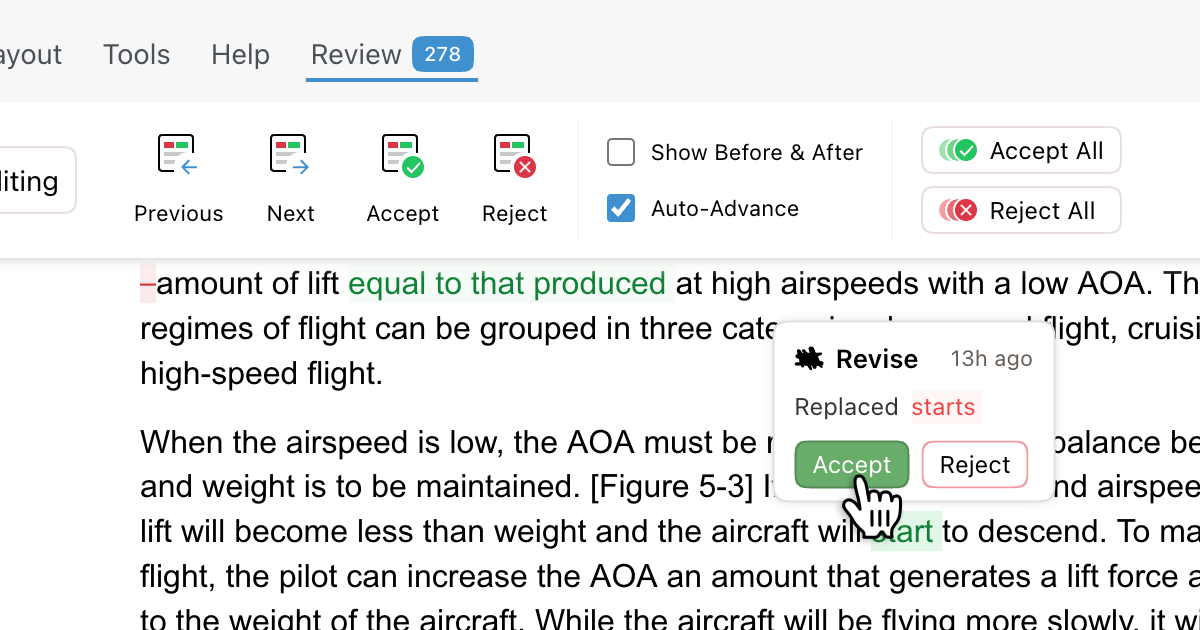
Both read uploaded .docx files. Claude can create .docx files on every plan, and Claude Docs exports to Word. Inside Word, Claude for Word (Pro and up) cites sections of the document, works through comment threads, and puts its edits into Word’s native tracked changes when Track Changes is on. ChatGPT for Word is available on every ChatGPT plan, including Free, subject to its usage limits. It drafts, summarizes, and revises selected text. OpenAI notes that complex formatting may need manual adjustment, and organization admins can block its installation. Outside Word, ChatGPT Work can create and edit documents, and OpenAI says its availability depends on your plan.
Edge: Claude is better for tracked revisions and for working through comments inside Word. ChatGPT is better if you want to use it on a Free account.
Drafting workspace
ChatGPT’s Canvas opens a document beside the chat, where you can mark up text and get inline suggestions. Claude Docs (beta, Pro and up) is a rich-text document where Claude drafts, leaves comments explaining its choices, and co-edits with you in real time. It has no version history yet.
Edge: Claude is better if you want to draft together and see its edits explained. ChatGPT is better if you want an editor side by side with the chat.
Which should you choose?
Choose ChatGPT if
- you want the lower-cost paid tier
- you want an AI add-in in Word on a Free account
- you already rely on ChatGPT memory and Projects
Choose Claude if
- you want the larger published context window
- you want edits as tracked changes inside Word
- you want .docx files back, including on the Free plan
What each costs
ChatGPT Go is billed monthly and may include ads, and Plus is $20 a month. Claude Pro is $20 a month, or $17 a month billed annually.
| Tool | Cheapest paid plan | Monthly | Per year | AI on that plan |
|---|---|---|---|---|
| ChatGPT | ChatGPT Go (monthly billing, may include ads) | $8/mo | $96 | More messages, uploads, and memory than Free |
| Claude | Claude Pro (or $17/mo billed annually) | $20/mo | $200 | More usage, Opus models, Claude Docs (beta), and Claude in Microsoft 365 |
Using both in one editor
Revise, the browser word processor that publishes this guide, runs GPT and Claude models (plus Gemini and Grok) in one editor and opens and exports .docx files. It shows text and formatting edits as tracked changes. It is a separate editor rather than a Word add-in, and its higher-end models need a paid plan.
The bottom line
Claude is the better choice if you want the larger published context and more editing features inside Word. ChatGPT is the better choice if you want the lower-cost paid tier or a Word add-in on the Free plan. On proofreading, the leading models were 0.8 points apart in our model benchmark. We have no controlled evidence that would let us name a winner on drafting quality.
Sources
Prices and plan details were checked against each vendor’s own pages on September 29, 2026. Prices are in US dollars as each vendor lists them, and some include local tax. Vendors change plans often, so confirm on the linked page before you buy.