Revise Blog - Building a post-AI word processor
Pages vs Word
A comparison of Apple’s free word processor and Microsoft Word on price, Word files, collaboration, and built-in AI
 Artur Sapek, Founder of Revise6 min read
Pages is free on supported Macs, iPhones, and iPads, and .docx is Word’s native format. If you exchange Word files or work with people on both Apple and Windows devices, the differences that matter most in practice are file conversion, which apps are available, and cost.
I have spent the past year building Revise, a word processor that opens and saves Word files while preserving the Word features it documents, so I pay close attention to how other apps handle those round trips. Plans and prices come from Apple’s and Microsoft’s own pages, which are linked in the sources at the end.
Pages vs Word at a glance
| Apple Pages | Microsoft Word | |
|---|---|---|
| Free plan | Yes (free on Apple devices) | Yes (Word for the web) |
| Paid from | $12.99/mo (Apple Creator Studio (optional)) | $9.99/mo (Microsoft 365 Personal) |
| Platforms | Mac, iPhone, iPad, Web (iCloud) | Web, Windows, Mac, iOS, Android |
| Word files | Yes (import and export) | Yes (native format) |
| Real-time co-editing | Yes (via iCloud) | Yes |
| Windows collaborators | Through iCloud.com in a browser | Windows app or Word for the web |
| Offline | Yes | Yes (desktop apps) |
| Built-in AI | Proofreads, rewrites, and summarizes selected text | Copilot drafts, rewrites, and summarizes, edits in place with highlight and undo |
To try Revise on a Mac, iPhone, or iPad, import a .docx (export it from Pages first) or paste your text below. It opens in your browser, and you don’t need an account.
Key differences
These are the differences we could check against Apple’s and Microsoft’s pages.
Price
Pages is free on supported Macs, iPhones, and iPads and is also available through iCloud.com. Apple Creator Studio is an optional subscription at $12.99 a month or $129 a year that adds premium templates and image tools. Word for the web is free with a Microsoft account, and the desktop apps come with Microsoft 365, which starts at $9.99 a month or $99.99 a year for Personal. On a Mac, Pages works offline for free, and Microsoft 365 Personal includes the desktop Word app.
Edge: Pages, because the core app is free on Apple devices.
Word files
.docx is Word’s native format, so a Word file opens in Word without conversion. Pages can import and edit Word files and export to Word on iPhone, iPad, Mac, and iCloud.com (Apple support). It exports to PDF on all of those, and to EPUB, RTF, and plain text on iPhone, iPad, and Mac. If a document goes back and forth with Word users, open the exported file in Word and check it after conversion.
Edge: Word, because .docx is its own format.
Collaboration
Pages supports real-time collaboration for up to 100 people through iCloud. Collaborators on Windows can join through iCloud.com in a browser (Apple support). Word supports real-time co-editing too.
Edge: Word, if your collaborators want native Windows or Android apps. Pages still lets Windows users join through iCloud.com.
Built-in AI
Pages uses Apple Intelligence Writing Tools, which can proofread, rewrite, and summarize text on devices that support Apple Intelligence, at no extra cost. Composing new text goes through the ChatGPT extension, which is available only in regions where ChatGPT is available (Writing Tools). Word’s AI is Copilot, which is included in Microsoft 365 Personal (and for the subscription owner on Family) with usage limits. Copilot drafts, rewrites, and summarizes. In our contract-review test, it changed the text directly and marked each change with a blue highlight and an undo button.
Edge: Pages on price, because Writing Tools don’t need an extra subscription on supported devices. We don’t have evidence that shows which one writes better output.
Platforms
Pages runs on Mac, iPhone, and iPad, and in a browser through iCloud. Word runs on the web, Windows, Mac, iOS, and Android.
Edge: Word, because it also has native apps for Windows and Android.
Which should you choose?
Choose Pages if
- you and your collaborators use Apple devices
- you do not want to pay for a word processor
- you want free AI proofreading on a supported Mac, iPhone, or iPad
Choose Word if
- your documents must stay in native .docx
- collaborators need native Windows or Android apps
- you want Copilot included in a Microsoft 365 plan
What each costs
You don’t need either paid plan to write, because Pages is free on Apple devices and Word for the web is free with a Microsoft account. Creator Studio is an optional add-on, and you don’t need it to use Pages. For desktop Word, the subscription compared here is Microsoft 365 Personal.
| Tool | Cheapest paid plan | Monthly | Per year | AI on that plan |
|---|---|---|---|---|
| Apple Pages | Apple Creator Studio (optional) | $12.99/mo | $129 | Creator Studio adds image tools, Writing Tools are free on supported devices |
| Microsoft Word | Microsoft 365 Personal | $9.99/mo | $99.99 | Eligible Microsoft 365 plans, with limits. Personal/Family AI benefits are for the owner |
Where Revise fits
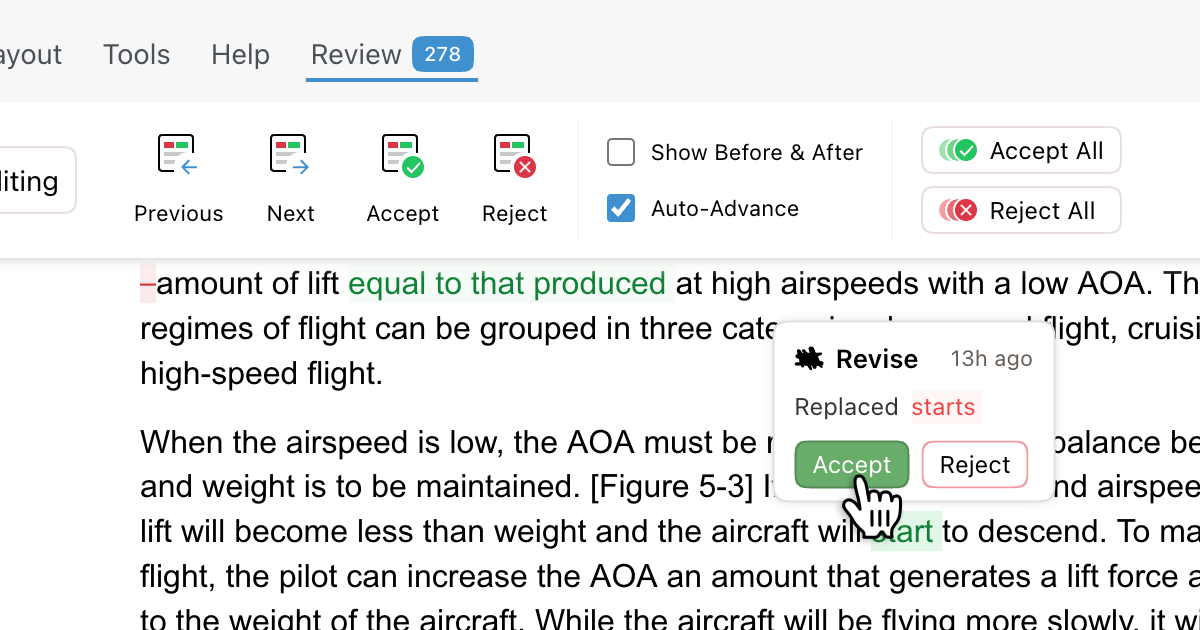
Revise, which publishes this guide, is a word processor that runs in the browser on Mac, iPhone, iPad, and Windows. It opens and saves .docx, and its AI agent proposes text and formatting edits as tracked changes. AI usage is limited by plan, and some models need a paid plan. It does not open Pages files, so they need to be exported to Word first, and it has no offline mode.
The bottom line
If you mostly work on Apple devices and exchanging .docx files is enough, Pages does the job for free. If documents must stay in native .docx or collaborators need native Windows or Android apps, Word is the better fit.
For more options, see Microsoft Word alternatives.
Sources
Prices and plan details were checked against each vendor’s own pages on October 4, 2026. Prices are in US dollars as each vendor lists them, and some include local tax. Vendors change plans often, so confirm on the linked page before you buy.
- Apple Pages: App Store listing, Collaborate in Pages, Word files in Pages, Pages, Creator Studio in Pages, Writing Tools
- Microsoft Word: AI capabilities and access, Previous versions, Track Changes, Navigation pane, Real-time co-authoring, Save as PDF, Compare documents (legal blackline), Microsoft 365 plans, Word for the web, Revise's AI review test, Copilot in Word, Track Changes in Word for the web, Word options: General, Print a document, Office for the web in OneDrive, Microsoft 365 mobile apps, Removed Windows features (WordPad), Word for the web service description, Similarity checking, Editing with Copilot and Track Changes (Microsoft 365 Copilot), Copilot and document length, When you need a Microsoft 365 subscription