Revise Blog - Building a post-AI word processor
The best AI for novel writing in 2026
Eight AI tools for fiction compared on what they do to your manuscript, which models they run, their entry price, and how AI use is metered
 Artur Sapek, Founder of Revise11 min read
People mean very different things by “AI for novel writing.” Some writers want help drafting scenes from an outline. Others write every word themselves and want a second reader, or a line editor that works through a finished manuscript. The tools below are built for different parts of that range, so the best one depends on which job you want AI to do.
I have spent the past year building a word processor with an AI agent that edits long documents, so I look closely at how each tool gets AI output into a manuscript and how much control you keep. I do not know of any controlled test of fiction prose quality across these tools, so this ranking is based on workflow, story context, and control rather than on whose prose reads best. The prices and features here come from each vendor’s own pages, which are linked throughout and at the end.
AI tools for novel writing at a glance
The “AI capabilities” column shows how the tools differ. Sudowrite, Novelcrafter, and NovelAI focus on generating story text. ProWritingAid analyzes a draft you already have. Revise can draft, but it ranks here for revising a whole manuscript in a way you can review. Claude, ChatGPT, and Gemini are general assistants that draft and edit in a chat or in their own document workspaces, and Claude for Word can also edit inside Word as tracked changes.
| Tool | Best for | Free plan | Paid from | AI capabilities |
|---|---|---|---|---|
| Sudowrite | Drafting fiction with AI built for it | No (free trial, no card required) | $19/mo (Hobby & Student) | Story Bible drafting, Write, Rewrite, Expand, Describe, and chat |
| Novelcrafter | A story codex with the AI model of your choice | No (21-day trial, all features) | $4/mo (Scribe) | Scene beats to prose, summaries, character extraction, and chat |
| Revise | Revising a written manuscript as tracked changes | Yes (daily AI limit) | $8/mo (Plus) | Agent proposes text and formatting edits as suggestions. Header, footer, and page-layout changes apply directly |
| ProWritingAid | Editing reports and chapter critiques in your own app | Yes (suggestions for 500 words at a time, 10 Rephrases a day) | $10/mo (Premium) | Grammar, style, and line-editing reports, Rephrase, Chapter Critique, paid manuscript analysis |
| NovelAI | Open-ended story continuation | Partial (free trial: 50 text generations) | $10/mo (Tablet) | Continues your story in the editor, with Lorebook and Memory context |
| Claude | Brainstorming and feedback on long uploads | Yes (Sonnet and Haiku models, no Claude Docs or Microsoft 365 add-ins) | $20/mo (Claude Pro) | Artifacts and Claude Docs for drafting, reads and creates DOCX and PDF files, Word add-in edits as tracked changes |
| ChatGPT | A general assistant with Canvas and a Word add-in | Yes (3 file uploads a day, 27K-token Instant context) | $8/mo (ChatGPT Go) | Writing blocks for revising a draft or selection, reads uploaded DOCX and PDF |
| Gemini | A low-cost general assistant tied to Google Docs | Yes (32K-token context, standard usage limits) | $4.99/mo (Google AI Plus) | Canvas docs you edit directly or through prompts, exports to Google Docs |
For a long book, the model is not the only thing that matters. It matters just as much how the tool keeps track of your story and how AI text gets into the manuscript.
| Tool | AI models | How AI text reaches the draft | Story context |
|---|---|---|---|
| Sudowrite | Muse and Ballad (its own fiction models), plus 30+ others including Claude | Generates options you choose from, or reworks a selection | Story Bible |
| Novelcrafter | Whatever you connect: OpenRouter, OpenAI, Claude, or a local model | Turns scene beats into prose in the editor | Codex with characters, aliases, relations, and mention tracking |
| Revise | Claude, GPT, Gemini, and Grok | Text and formatting edits as tracked changes, or comments | The open manuscript, read by outline and section when long, but no story bible |
| ProWritingAid | Not disclosed | Inline suggestions, reports, and Rephrase | Custom style guide (Premium) |
| NovelAI | GLM-4.6, Xialong, and Erato | Continues your text directly in the editor, with undo and Retry | Lorebook, Memory, and Author's Note |
| Claude | Claude | Chat replies and artifacts, Claude Docs and the Claude for Word add-in (tracked changes) on Pro and up | Uploaded files, up to five projects on Free, unlimited on Pro |
| ChatGPT | GPT | Chat replies, inline Canvas edits, ChatGPT for Word add-in | Memory and uploaded files |
| Gemini | Gemini | Chat replies, Canvas documents, export to Google Docs | Gems and uploaded files |
To see AI revision as tracked changes on your own pages, paste a chapter below or import a .docx, then ask for an edit. It opens in Revise in your browser, where you can try one AI request without an account. You need a free account to accept a suggested change.
How we evaluated them
We looked at each tool as part of a novelist’s workflow and used these five checks:
- Can it keep characters, places, and earlier chapters in view across a whole book?
- Can you see exactly what the AI wrote or changed, and keep or discard it piece by piece?
- Which models does it run, and can you choose between them?
- Can you import a
.docxand export it again? - What is the entry price, which plan is the first with the relevant AI feature, and how is usage metered?
The ranking puts fiction-specific and manuscript-specific workflows first. General assistants rank after them because they are built for general tasks rather than for a manuscript. That does not mean their models write worse, and if you mainly want to brainstorm, one of them may be all you need.
The 8 best AI tools for novel writing
1. Sudowrite: Best for drafting fiction with AI
- Free plan: No, free trial
- Paid from: $19/mo
- Built-in AI: Sudowrite
Sudowrite combines a fiction-focused Story Bible with scene generation, rewriting, description, chat, and manuscript feedback. The Story Bible takes a book from concept to outline to chapters. Write offers several continuations of about 300 words, and Rewrite, Expand, and Describe work on a passage you select. It runs its own fiction models, Muse and Ballad, plus 30+ others including Claude. Importing a novel fills in the Story Bible, and it exports .docx.
Plans are metered in credits. Hobby & Student includes 225,000 credits for $19 a month, or $120 a year ($10 a month equivalent). Feedback (developmental edits, line edits, and beta reads) needs the Professional plan at $29 a month, or $264 a year ($22 a month equivalent). Sudowrite says it does not train on your writing.
Pick it if you want AI to help generate scenes and chapters from your plan. Skip it if you want AI to stay out of the drafting.
2. Novelcrafter: Best for story context with your own model
- Free plan: No, 21-day trial
- Paid from: $4/mo
- Built-in AI: Connect your own AI (OpenRouter, OpenAI, Claude, local)
Novelcrafter is a novel writing app with a Codex that works like a wiki for your book. It holds characters, places, aliases, relations, and progressions, and it tracks every mention of them in the text. The AI can turn scene beats into prose, summarize scenes, and extract characters, and it uses the Codex for context.
It provides no AI model of its own. From the Hobbyist plan ($8 a month) you connect OpenRouter, OpenAI, Anthropic, another provider, or a local model. That gives it the widest choice of models in this list, and usage is handled by whichever provider you connect.
Pick it if you want a story bible and control over which model writes. Skip it if you do not want to set up an AI provider.
3. Revise: Best for revising a written manuscript
- Free plan: Yes, daily AI limit
- Paid from: $8/mo
- Built-in AI: Revise Agent
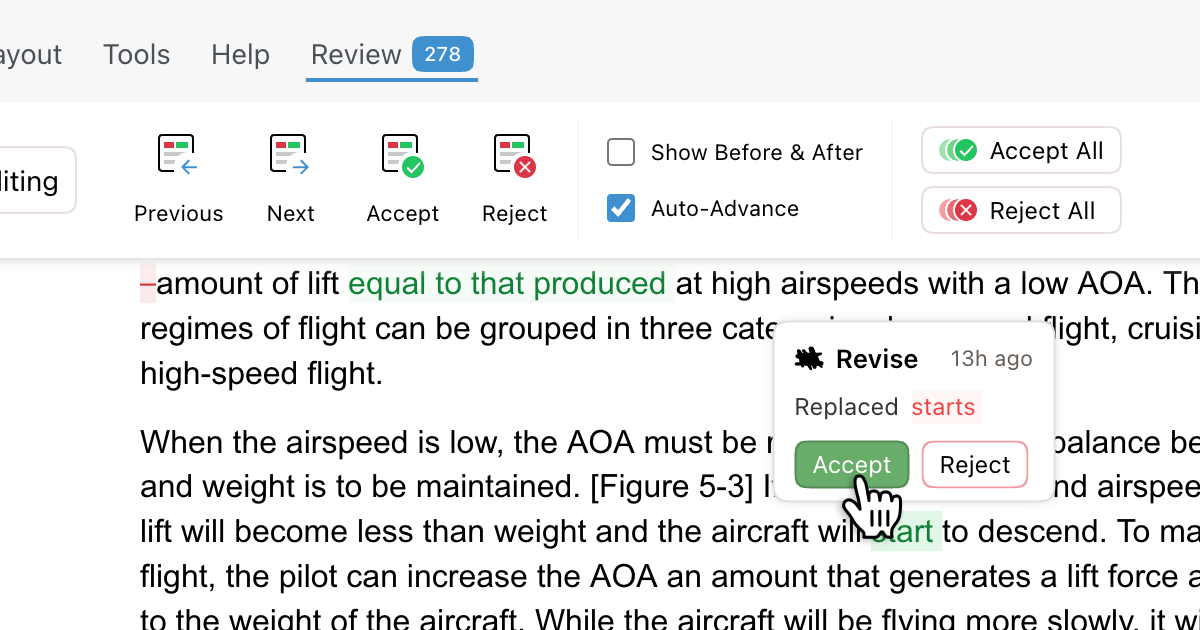
Revise is a browser word processor with an AI agent. It can draft and rewrite, but it ranks here for revising an existing manuscript. You can ask for a line edit, a continuity check, or tighter dialogue, and the agent proposes wording and formatting edits as tracked changes that you accept or reject. On a long manuscript it reads by outline and section and proofreads in batches.
The free plan includes GPT-6 Luna, subject to a daily limit, and other GPT, Claude, Gemini, and Grok models come with Plus ($8 a month) and Pro. A .docx manuscript imports with its tracked changes and comments, and pending AI edits export to Word as tracked changes.
Claude for Word can also make AI edits as tracked changes, inside Word on Claude Pro and up. Revise is a separate editor, not an add-in, and it has no story bible or codex. Pick it if you have a draft and want AI edits you review one by one. Skip it if you want a fiction-specific story bible and outline-to-scene workflow.
4. ProWritingAid: Best for editing reports and critiques
- Free plan: Yes, 500 words at a time
- Paid from: $10/mo
- Built-in AI: ProWritingAid
ProWritingAid is a grammar and style checker aimed at fiction writers, and it says it will never write your book for you. Premium adds unlimited line editing and Rephrase, 25+ reports, a custom style guide, and one Chapter Critique a day. You can buy Story Credits for manuscript, plot, and character analysis and a virtual beta reader.
It works inside Word, Google Docs, and Scrivener, so you keep your writing app. Premium is $10 a month billed yearly ($120), $30 month to month, or $399 for life. It supports English only.
Pick it if you want fiction-oriented reports, chapter critiques, and optional line-level rewrites inside your existing writing app. Skip it if you want AI to draft scenes.
5. NovelAI: Best for open-ended story continuation
- Free plan: Trial, 50 generations
- Paid from: $10/mo
- Built-in AI: NovelAI
NovelAI continues your story in its editor. AI text appears in color, and you can undo it, retry, or keep writing. You give it characters and style through a Lorebook, Memory, and Author’s Note. It runs GLM-4.6, Erato (built on Llama 3 70B), and, on the Opus tier only, Xialong, and it also generates images.
Paid tiers ($10, $15, and $25 a month) include unlimited text generation. The Opus tier has the largest context, at 28,672 tokens. The free trial covers 50 text generations.
Pick it if you like writing interactively with an AI co-author. Skip it if you want structured manuscript critiques rather than open-ended continuation.
6. Claude: Best general assistant for long uploads
- Free plan: Yes, Sonnet and Haiku
- Paid from: $20/mo
- Built-in AI: Claude
Claude is Anthropic’s general assistant. A novelist can use it to brainstorm and as a reader. You can upload chapters (PDFs up to 1,000 pages), keep them in a project, ask for feedback, or draft in an artifact. Anthropic lists a maximum context of up to 1M tokens, varying by model. Claude Docs (beta, Pro and up) is a shared document where Claude drafts, edits with you in real time, and leaves comments explaining its choices. It has no version history yet.
The free plan runs Sonnet and Haiku models. Pro ($20 a month, or $17 billed annually) adds Opus models and Claude Docs. Claude can create .docx files on every plan.
Pick it if you want a flexible reader that accepts very long uploads. Skip it if you want a fiction-specific codex that tracks characters, places, and mentions for you.
7. ChatGPT: Best general assistant inside Word
- Free plan: Yes, 3 uploads/day
- Paid from: $8/mo
- Built-in AI: ChatGPT
ChatGPT covers brainstorming, feedback, and drafting in chat, with Canvas for marking up text and getting inline suggestions. Memory keeps preferences between conversations, and the ChatGPT for Word add-in works on every plan.
Go costs $8 a month (monthly billing, may include ads), and Plus is $20. The free plan allows three file uploads a day and a 27K-token standard context, which OpenAI puts at roughly 12 pages of input.
Pick it if you want a general assistant that also works inside Word. Skip it if you want a purpose-built novel workspace rather than a general assistant.
8. Gemini: Best low-cost general assistant
- Free plan: Yes, 32K context
- Paid from: $4.99/mo
- Built-in AI: Gemini
Gemini is Google’s assistant. Its Canvas creates documents that you can edit directly or by asking Gemini, and responses export to Google Docs. Gems, which are custom assistants you set up once, are on the free plan.
Google AI Plus is $4.99 a month, with twice the free usage and a 128K-token context. Gemini inside Google Docs and a 1M-token context start with Google AI Pro at $19.99.
Pick it if you write in Google Docs and want a low-cost assistant. Skip it if you want a fiction-specific story bible.
Which AI fits how you write?
Fiction tools keep track of story structure for you. A general assistant is enough for occasional brainstorming or work on a single passage, as long as you supply the context.
| What you want from AI | Best fit | When a general assistant is enough |
|---|---|---|
| Draft scenes and chapters from an outline | Sudowrite | You draft a scene at a time and paste in the context yourself. |
| A story bible plus your choice of model | Novelcrafter | Your notes fit in a project or a few uploaded files. |
| Edits across a manuscript, reviewed one by one | Revise | You edit inside Word with Claude for Word (Claude Pro and up), or you revise a passage at a time. |
| Structured reports and chapter critiques | ProWritingAid | You want a general read rather than grammar and style reports. |
| Interactive, open-ended storytelling | NovelAI | You only need occasional continuation and are comfortable supplying the story context yourself. |
What general assistants still do best
- One subscription for everything. You can use the same plan for research, email, and the book.
- Large published maximums. Claude lists context of up to 1M tokens, depending on the model. Gemini reaches 1M on AI Pro, and ChatGPT’s reasoning models reach 256K on Go and Plus. These are upper limits and do not measure how well each one reads a novel.
- Word add-ins. ChatGPT for Word works on every ChatGPT plan, and Claude for Word on Claude Pro and up.
- Free plans. All three have one, subject to usage limits.
What each costs
These tools meter AI use in different ways. Sudowrite uses credits, and Novelcrafter leaves model costs to the provider you connect. NovelAI’s paid tiers include unlimited text generation, and Revise, Claude, ChatGPT, and Gemini meter usage against plan limits. The yearly column uses the vendor’s annual price where it is verified, or twelve monthly payments when no annual price is listed. A dash means we have not verified the annual price, or the plan is a one-time purchase. Novelcrafter and Gemini’s annual prices are not listed here.
| Tool | Cheapest paid plan | Monthly | Per year | AI on that plan |
|---|---|---|---|---|
| Sudowrite | Hobby & Student (225,000 credits/month, annual billing is $120/year ($10/month equivalent)) | $19/mo | $120 | 225,000 credits a month, Feedback needs Professional |
| Novelcrafter | Scribe (billed monthly, annual billing gives 2 months off) | $4/mo | - | None, AI integration starts on Hobbyist ($8/mo) |
| Revise | Plus (or $72/yr billed annually) | $8/mo | $72 | Monthly AI limit, no daily limit. GPT-6 Sol, GPT-6 Astra, and Claude Opus 5.5 need Pro |
| ProWritingAid | Premium (billed yearly ($120), $30 month to month) | $10/mo | $120 | Unlimited Rephrases, 1 Chapter Critique and 5 Sparks a day |
| NovelAI | Tablet (per month, Scroll $15, Opus $25) | $10/mo | $120 | Unlimited text generation, smaller context than Opus |
| Claude | Claude Pro (or $17/mo billed annually) | $20/mo | $200 | More usage, Opus models, Claude Docs (beta), and Claude in Microsoft 365 |
| ChatGPT | ChatGPT Go (monthly billing, may include ads) | $8/mo | $96 | More messages, uploads, and memory than Free |
| Gemini | Google AI Plus (per month) | $4.99/mo | $59.88 | 2x Free usage and 128K context, Gemini in Docs and 1M context start with AI Pro ($19.99/mo) |
Using AI on a manuscript without losing control
- Keep a copy. Save the manuscript before any AI pass, or use a tool with version history.
- Give it context once. A story bible, codex, lorebook, project, or custom instructions means you do not have to explain characters and style again in every request.
- Ask for one kind of change at a time. A continuity pass followed by a dialogue pass is easier to review than a request to “make it better”.
- Review every change. Accept or reject edits one by one where the tool allows it, and read AI-generated passages as closely as you would read a stranger’s writing.
The bottom line
Start by deciding which job you want AI to do. For drafting, use Sudowrite, or Novelcrafter if you want to pick the model. For critique, use ProWritingAid, and for continuation, use NovelAI. To revise a finished draft with edits you accept or reject, use Revise. For brainstorming, a general assistant you may already pay for is enough.
Sources
Prices and plan details were checked against each vendor’s own pages on October 4, 2026. Prices are in US dollars as each vendor lists them, and some include local tax. Vendors change plans often, so confirm on the linked page before you buy.
- Sudowrite: Pricing, Plan prices and billing, Sudowrite, Exporting files, Importing files
- Novelcrafter: Pricing, Features, Does Novelcrafter provide its own AI?, Export, Word import
- Revise: Pricing, Supported models, Agent capabilities, Word compatibility, Import and export, MCP server, Suggesting mode, AI usage limits
- ProWritingAid: Pricing, System requirements, Word for the web, Home page
- NovelAI: NovelAI, Subscription tiers, Text models, Editor, Lorebook
- Claude: Pricing, Upload files, Create and edit files, Claude Docs, Claude for Word, Custom connectors
- ChatGPT: Pricing, Free tier FAQ, File uploads FAQ, Writing blocks, ChatGPT for Word, Capabilities overview, ChatGPT for Word, Creating documents with ChatGPT Work, Google Drive app, Google app data controls, Supported file types, ChatGPT for Google Sheets
- Gemini: Plans, Limits and upgrades, Canvas, Upload files, Export responses, October 2026 model access changes