Revise Blog - Building a post-AI word processor
The best Notion alternatives for writing and documents in 2026
Seven apps compared on price, AI, Word files, page layout, and offline use, for people who need document layout, export, or private notes
 Artur Sapek, Founder of Revise9 min read
Notion is good at linking pages, wikis, and databases in one workspace. It works less well for documents that leave the workspace. Pages scroll rather than paginate, and Word files can be imported but not exported again as .docx. The full Notion AI also starts on the Business plan. This guide covers three reasons people leave, which are that they need a paginated word processor, private notes they control, or a dedicated team wiki. It ranks the options for writing and documents, not for project management.
I have spent the past year building a word processor around an AI agent, so I have studied how each of these tools stores, formats, and exports text. The prices and plans here come from each vendor’s own pages, which are linked in the sources at the end.
Notion alternatives at a glance
Start with the “Best for” column. These apps solve different problems, and the right one depends on what your Notion pages are used for.
| Tool | Best for | Free plan | Paid from | AI capabilities |
|---|---|---|---|---|
| Revise | Formatted documents with AI edits you review as tracked changes | Yes (daily AI limit) | $8/mo (Plus) | Agent proposes text and formatting edits as suggestions. Header, footer, and page-layout changes apply directly |
| Google Docs | Free shared documents with page layout | Yes (with a Google account) | $7/mo (Workspace Business Starter) | Gemini drafts, rewrites, and summarizes, refinements you accept or reject |
| Craft | Offline, block-based docs in native apps | Yes (1,500 blocks, 15 AI credits) | $6.40/mo (Plus) | Brainstorms, summarizes, rewords, fixes grammar, translates, you insert results |
| Obsidian | Private notes stored as local Markdown files | Yes (free without limits, Obsidian Sync is a paid add-on) | $4/mo (Sync (optional add-on)) | None built in |
| Coda (Superhuman Docs) | Docs combined with tables and databases | Yes (limited pages and objects in shared docs) | $12/mo (Superhuman Pro) | AI chat and writing help inside docs, AI views and pages in beta |
| Confluence | Team wikis and internal documentation | Yes (up to 10 users, 2 GB storage) | $6.70/mo (Standard) | Rovo Search, Chat, and Agents, drafts content, fixes errors, changes tone |
| Anytype | Local-first, encrypted notes and databases | Yes (100 MB remote storage, 10 shared channels) | $4/mo (Plus) | None built in |
The second table covers the features that separate a document editor from a notes app. Revise and Google Docs paginate and can import and export .docx. Confluence imports and exports Word files, and Craft exports them on Mac, iOS, and the web. Obsidian, Craft, and Anytype keep working offline, which Revise does not.
| Tool | .docx | Page layout | Offline |
|---|---|---|---|
| Revise | Yes (import and export) | Yes | No |
| Google Docs | Yes (edits .docx directly, imports and exports) | Yes | Yes |
| Craft | Partial (export only, on Mac, iOS, and web) | No (pages scroll, no print layout) | Yes |
| Obsidian | No (Markdown files, no Word importer) | No (notes scroll, no print layout) | Yes (files stored on your device) |
| Coda (Superhuman Docs) | No (no Word importer listed, PDF export) | No (pages scroll, no print layout) | - |
| Confluence | Yes (imports .docx, exports pages to Word) | No (pages scroll, no print layout) | - |
| Anytype | No (exports Markdown, PDF, HTML) | No (pages scroll, no print layout) | Yes (offline-first) |
The quickest way to test the top pick is to copy a Notion page and paste it below, or to import a Markdown file exported from Notion. It opens in Revise in your browser, and you do not need an account for your first AI request.
How we evaluated them
We compared each alternative against Notion, which has a free plan, block-based pages, linked databases, real-time collaboration, and an AI assistant that is only a trial until the Business plan. We used these six checks:
- Can it produce a paginated document with headers, footers, and footnotes?
- Can it import and export
.docx, and can you move your Notion pages into it? - What can the built-in AI do, and on which plan?
- Can two people edit the same page at once?
- Where is your text stored, and does it work offline?
- What does one person pay for the plan that includes the features above?
The ranking weighs the first three most heavily, because this guide is for people who use Notion to write. If you use Notion mainly as a wiki or a notes database, the fit table further down is a better guide than the order of the list. ClickUp Docs and other tools built around project management are left out for the same reason.
The 7 best Notion alternatives for writing
1. Revise: Best for formatted documents with AI editing
- Free plan: Yes, daily AI limit
- Paid from: $8/mo
- Built-in AI: Revise Agent
Revise is a browser word processor with a built-in AI agent. It has paginated layout and real-time co-editing. It imports Markdown, one of Notion’s export formats, and exports .docx and PDF.
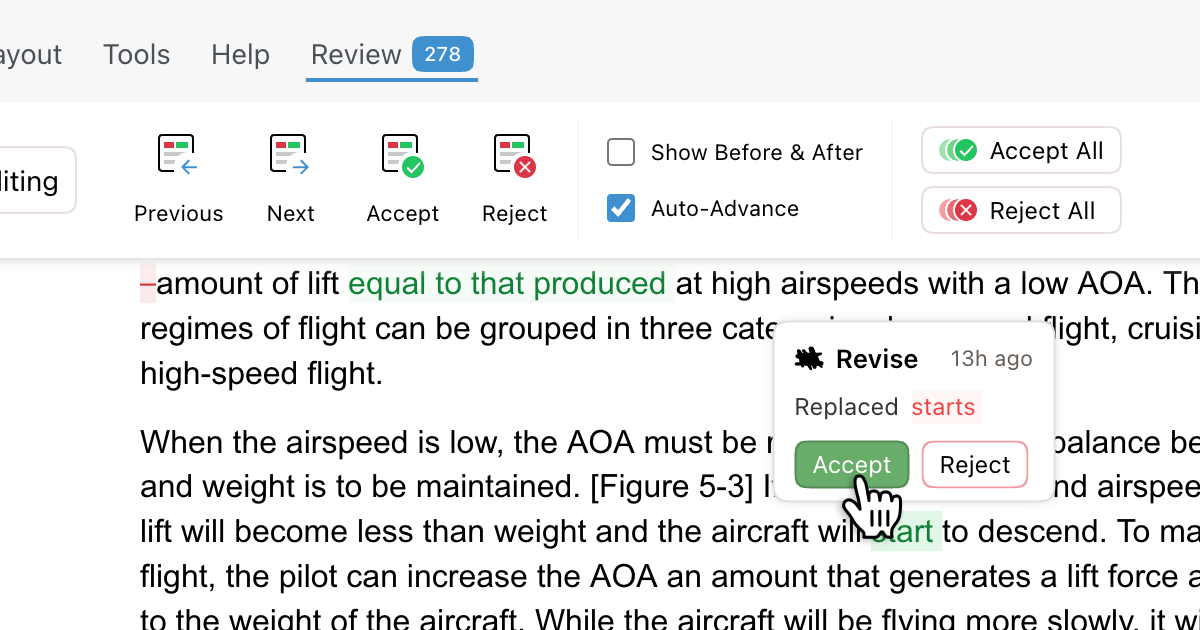
The agent proposes text and formatting edits across the whole document as tracked changes that you accept or reject. The free plan includes GPT-6 Luna with a daily limit, and the other models need a paid plan. Revise has folders of documents but no databases or linked wiki pages, and it needs an internet connection.
Pick it if your pages need to become documents you print, file, or send as .docx, or you want AI edits you can review one by one. Skip it if you rely on databases and linked pages, or need to write offline.
2. Google Docs: Best free option for shared documents
- Free plan: Yes, with a Google account
- Paid from: $7/mo
- Built-in AI: Gemini
Google Docs is free with a Google account. It has paginated layout and exports .docx, which Notion does not. Like Notion, it also imports Word files, works offline, and supports real-time co-editing.
Gemini drafts, rewrites, and summarizes, and shows refinements you accept or reject. It is not included in Workspace Business Starter. It starts with Business Standard ($14 per user per month with an annual commitment) or, for individuals, Google AI Pro ($19.99 per month).
Pick it if you want free, familiar documents that anyone can open. Skip it if you want Notion-style linked pages and databases.
3. Craft: Best for offline, block-based docs
- Free plan: Yes, 1,500 blocks
- Paid from: $6.40/mo
- Built-in AI: Craft Assistant
Craft is a block-based notes and docs app like Notion, and it has native apps for Mac, Windows, iOS, iPadOS, and Android plus a web version. It works offline and supports real-time collaboration.
Craft Assistant brainstorms, summarizes, rewords, fixes grammar, and translates text, and you copy or insert its answers yourself. You can run it on Craft’s models, on-device models, or your own OpenAI or Anthropic key. Word export works on Mac, iOS, and the web, but not on Windows, and pages scroll rather than paginate.
Pick it if you want Notion’s block editing in a native app that works offline. Skip it if your documents need print layout.
4. Obsidian: Best for private notes you own
- Free plan: Yes, Obsidian Sync is paid
- Paid from: $4/mo
- Built-in AI: None
Obsidian stores notes as Markdown files on your own device, works offline, and is free without limits on Windows, Mac, Linux, iOS, and Android. Its Notion importer can move your pages into it.
Obsidian’s own Sync service is a paid add-on, though its sync guide also covers iCloud, OneDrive, Google Drive, Syncthing, and Git. Shared vaults need Sync for every collaborator. Obsidian does not support live co-editing. There is no built-in AI and no Word importer.
Pick it if you write alone and want plain Markdown files stored on your own device. Skip it if you co-edit with other people or send Word files.
5. Coda (Superhuman Docs): Best for docs with databases
- Free plan: Yes, limited shared docs
- Paid from: $12/mo
- Built-in AI: Docs AI assistant
Coda, now sold as Superhuman Docs, combines pages with tables the way Notion does, and it imports from Notion, Google Docs, Confluence, and Markdown.
The free plan limits pages and objects in shared docs. Docs AI adds chat and writing help inside docs, but the cheapest paid plan includes it only as a limited trial. Full access starts on the Business plan. It exports PDF but lists no Word import or export.
Pick it if you use Notion for docs built around tables. Skip it if you need paginated print layout or Word export.
6. Confluence: Best for team wikis
- Free plan: Yes, up to 10 users
- Paid from: $6.70/mo
- Built-in AI: Rovo
Confluence is Atlassian’s team wiki, and it is free for up to 10 users. It imports .docx and exports pages to Word, which Notion does not.
Its AI is called Rovo. It can search, chat, run agents, draft content, fix errors, and change tone. Paid plans include Rovo credits (25 per user a month on Standard), and the free plan has none.
Pick it if your Notion workspace is mostly team documentation. Skip it if you want local files, offline writing, or paginated print layout.
7. Anytype: Best for local-first, encrypted notes
- Free plan: Yes, 100 MB sync storage
- Paid from: $4/mo
- Built-in AI: None
Anytype has pages and databases like Notion, but it keeps your data on your devices first and encrypts it. It works offline, has apps for Mac, Windows, Linux, iOS, and Android, and has a Notion migration guide .
There is no browser version and no built-in AI. It exports Markdown, PDF, and HTML, but not Word. Its code is source-available rather than open source.
Pick it if you want Notion’s structure without a cloud-first service. Skip it if you need a browser version or Word files.
Which alternative fits your job?
Start by deciding what your Notion pages are for. For documents that leave the workspace, look at Revise or Google Docs. For local or local-first notes, look at Obsidian or Anytype. Craft fits offline block-based docs, Confluence fits a team knowledge base, and Coda fits docs built around tables.
| Why you are leaving | Best fit | When Notion still wins |
|---|---|---|
| Pages need to become Word files or PDFs with real layout | Revise or Google Docs | The page never leaves the workspace. |
| AI edits you can review one change at a time | Revise | You want AI that searches and answers across the whole workspace. |
| Free documents that anyone can open | Google Docs | You need databases alongside the documents. |
| A native app with block editing that works offline | Craft | You need linked databases and wiki pages alongside the documents. |
| Notes as plain files on your own device | Obsidian | You co-edit pages with other people. |
| Docs built around tables and databases | Coda | Your workflow is already built in Notion. |
| A dedicated team wiki with Word import and export | Confluence | Your team wants wiki pages and databases in one tool. |
| Encrypted, local-first pages and databases | Anytype | You need a browser version. |
What Notion still does best
- Pages and databases together. Wikis, notes, and databases are kept in one block-based workspace.
- Workspace-wide AI. Notion AI can search the workspace, answer questions, and write or rewrite blocks.
- Apps on every platform. Notion runs on the web, Windows, Mac, iOS, and Android, and the desktop and mobile apps work offline.
- A free plan. It includes real-time collaboration.
Some people keep Notion for planning and linked notes and use one dedicated tool for the documents that leave the workspace.
What each alternative costs
Every tool here has a free plan, and Obsidian is free outright unless you pay for Sync. The paid tiers add different things. Some tools add more AI, others add device sync or storage, and Google Workspace and Notion add broader workspace features. Confluence Standard is priced per user per month, but if you pay annually it is a flat $680 for 1 to 10 users. Notion is listed last for comparison. Its Plus plan includes Notion AI only as a trial, and the full version starts on Business ($20 per seat per month).
| Tool | Cheapest paid plan | Monthly | Per year | AI on that plan |
|---|---|---|---|---|
| Revise | Plus (or $72/yr billed annually) | $8/mo | $72 | Monthly AI limit, no daily limit. GPT-6 Sol, GPT-6 Astra, and Claude Opus 5.5 need Pro |
| Google Docs | Workspace Business Starter (per user, annual plan) | $7/mo | $84 | Not on Starter, Gemini in Docs starts with Business Standard ($14/user/mo with annual commitment) or Google AI Pro ($19.99/mo) |
| Craft | Plus (billed yearly ($8 monthly)) | $6.40/mo | $76.80 | 50 AI credits a month, own key or on-device models free |
| Obsidian | Sync (optional add-on) (per user, billed yearly ($5 monthly)) | $4/mo | $48 | None |
| Coda (Superhuman Docs) | Superhuman Pro (per member, billed annually ($15 monthly)) | $12/mo | $144 | Limited trial, full Docs AI starts on Business ($33/member/mo, billed annually) |
| Confluence | Standard (per user, billed monthly, annual is a flat $680 for 1-10 users) | $6.70/mo | - | 25 Rovo credits per user a month (none on Free) |
| Anytype | Plus (billed yearly ($5 monthly)) | $4/mo | $48 | None |
| Notion | Plus (per seat, billed yearly ($12 monthly)) | $10/mo | $120 | Limited trial on Free/Plus. Business and Enterprise include AI with feature allowances |
How to switch from Notion
Notion exports pages as PDF, HTML, or Markdown, and full-page databases as CSV.
- Export. Open the ••• menu on a page, choose Export, and pick Markdown & CSV. Turn on subpages to export a whole section.
- Import. Obsidian, Anytype, and Coda have Notion importers, and Revise imports the exported Markdown files.
- Rebuild what does not transfer. Databases are exported as CSV files, so decide whether they belong in a spreadsheet, in Coda, or in Anytype.
- Check the formatting. Blocks that exist only in Notion may be simplified in the new app, so review each page once.
The bottom line
Choose a workspace or notes app if your pages need to stay connected to databases and team knowledge. Choose a word processor if they need to become files with controlled page layout.
For more comparisons, see the best Google Docs alternatives.
Sources
Prices and plan details were checked against each vendor’s own pages on October 4, 2026. Prices are in US dollars as each vendor lists them, and some include local tax. Vendors change plans often, so confirm on the linked page before you buy.
- Revise: Pricing, Supported models, Agent capabilities, Word compatibility, Import and export, MCP server, Suggesting mode, AI usage limits
- Google Docs: Edit Office files, Version history, Suggest edits, Workspace pricing, Google AI plans, Gemini in Docs, Gemini features by plan, Gemini usage limits in Google apps, Edit Office files in Google Drive
- Craft: Pricing, Export formats, Bring your own key
- Obsidian: Import from Notion, Pricing, Download, Shared vaults
- Coda (Superhuman Docs): Plans, Export options, Import options
- Confluence: Pricing, Rovo usage limits, Import documents, Export to Word, Mobile app
- Anytype: Migrate from Notion, Pricing, Import and export, Source license
- Notion: AI capabilities and access, Export your content, Pricing, Working offline