Revise Blog - Building a post-AI word processor
The best AI document editors in 2026
Eight editors compared on how their AI changes your document, which models it runs, and what happens to your Word files
 Artur Sapek, Founder of Revise10 min read
An AI document editor is a place where the document and the AI live together, so you do not paste text into a chat and back out again. Many writing apps now include an AI assistant, and the chat assistants have added document workspaces of their own, but they work very differently. Some revise a whole document and show you every change. Others rewrite in place, and some mostly answer in a side panel.
I have spent the past year building Revise, a word processor with an AI agent, so I have used each of these closely and tested several of them on the same document. Prices, plans, and features come from each vendor’s own pages, checked in October 2026 and linked in the sources at the end.
AI document editors at a glance
The “AI capabilities” column is where these tools differ most. Read it with two questions in mind: can the AI work on the whole document, and can you see and reject what it changed?
| Tool | Best for | Free plan | Paid plan with AI | AI capabilities |
|---|---|---|---|---|
| Revise | Whole-document AI edits you review as tracked changes | Yes (daily AI limit) | $8/mo (Plus) | Agent proposes text and formatting edits as suggestions. Header, footer, and page-layout changes apply directly |
| Microsoft Word | Teams on Microsoft 365 | Yes (Word for the web) | $9.99/mo (Microsoft 365 Personal) | Copilot drafts, rewrites, and summarizes, edits in place with highlight and undo. Track Changes edits in a business preview |
| Google Docs | Teams on Google Workspace | Yes (with a Google account) | $14/mo (Workspace Business Standard) | Gemini drafts, rewrites, and summarizes, proposed edits appear as suggestions you accept or reject |
| Zoho Writer | A free online word processor with AI | Yes (all editing features, extra automation credits paid) | Free | Zia drafts, rewrites, and summarizes a selection or the whole document, prompt edits arrive as suggested changes |
| Claude | Drafting and feedback in Claude Docs | Yes (Sonnet and Haiku models and Claude Docs, no Microsoft 365 add-ins) | $20/mo (Claude Pro) | Edits Claude Docs directly and explains changes in comments, reads and creates DOCX and PDF, Word add-in edits as tracked changes |
| ChatGPT | ChatGPT users, with an add-in for Word | Yes (3 file uploads a day, 27K-token Instant context) | $8/mo (ChatGPT Go) | Writing blocks for revising a draft or selection, reads uploaded DOCX and PDF |
| Grammarly | Proofreading and AI agents in Grammarly Docs | Yes (100 AI prompts a month) | $12/mo (Pro) | Grammar, tone, and sentence rewrites as inline suggestions, AI detection |
| Notion | AI across a team wiki | Yes (AI as a trial) | $20/mo (Business) | Searches the workspace, answers questions, writes and rewrites blocks |
The second table covers the document itself. Paginated layout and .docx support matter if your document ends up in Word, in print, or with someone who reviews it in Word.
| Tool | AI models | Real-time co-editing | .docx | Page layout |
|---|---|---|---|---|
| Revise | Claude, GPT, Gemini, Grok, Muse | Yes | Yes (import and export) | Yes |
| Microsoft Word | GPT and Claude, model selector varies by plan | Yes | Yes (native format) | Yes |
| Google Docs | Gemini | Yes | Yes (edits .docx directly, imports and exports) | Yes |
| Zoho Writer | Zoho's own model, or OpenAI with your own key | Yes | Yes (import and export) | Yes |
| Claude | Claude | Yes (in Claude Docs) | Yes (upload, create, and export) | - |
| ChatGPT | GPT | - | Yes (upload, file creation via ChatGPT Work) | - |
| Grammarly | Not disclosed | No (in development for Grammarly Docs) | Partial (Grammarly Docs exports to Word) | - |
| Notion | - | Yes | Partial (import only) | No (pages scroll, no print layout) |
To try the top pick on your own document, paste it below or import the .docx. It opens as a separate document in Revise in your browser. The Free plan has a daily AI limit, and the larger models need a paid plan.
How we evaluated them
Each editor was judged on the work people bring to an AI document editor: drafting, revising a long draft, and getting a document reviewed. Six checks:
- Reach: can the AI work across the whole document, or only on a selection or in a chat?
- Review: does each change show up as something you can accept or reject?
- Models: which AI models it runs, and whether you can choose.
- The document: page layout, headers and footers, footnotes, and whether a real
.docxsurvives import and export. - Collaboration: co-editing, comments, and sharing.
- Price: the cheapest paid plan for one person that includes the AI described here.
Feature descriptions come from each vendor’s current documentation. Where I mention how a tool behaved in practice, it comes from our hands-on review test, which ran Revise, Word with Copilot, Google Docs with Gemini, ChatGPT, and Claude on the same contract earlier in 2026. Products change quickly, so treat those results as a snapshot. The ranking weighs reach, review, and the document most heavily. If your priority is different, the fit table further down is a better guide than the order of the list.
The 8 best AI document editors
1. Revise: Best for AI edits you review as tracked changes
- Free plan: Yes, daily AI limit
- Paid from: $8/mo
- Built-in AI: Revise Agent
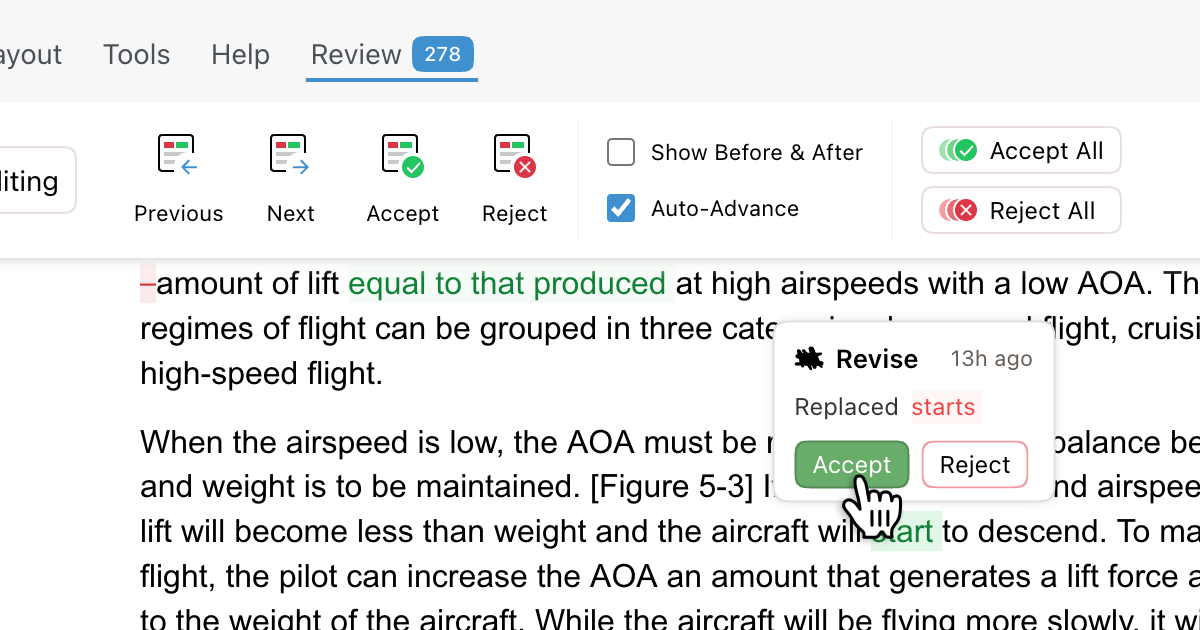
Revise is a browser word processor built around an AI agent. The agent reads the whole document and proposes text and formatting edits as suggestions, shown in green and red, that you accept or reject one at a time or all at once. It can draft, rewrite, restructure, and work through a long document section by section. Header, footer, and page layout changes apply directly rather than as suggestions. You pick the model: Claude, GPT, Gemini, Grok, or Meta’s Muse.
The editor preserves the Word features it documents, including per-section page setup, headers and footers, footnotes, legal numbering, and comments. Word tracked changes import as suggestions, and pending AI suggestions export to Word as tracked changes. It also has real-time co-editing, comments, and a revision history that shows what changed as a red and green diff.
Pick it if you want whole-document text and formatting edits as suggestions you approve one at a time, on a model you choose, with Word layout and tracked changes that carry over to Word. Skip it if you need an add-in inside Word itself, a desktop app, or the largest models without a paid plan.
2. Microsoft Word with Copilot: Best for teams on Microsoft 365
- Free plan: Yes, Word for the web
- Paid from: $9.99/mo
- Built-in AI: Copilot
Microsoft Word is the native home of .docx, and Copilot can draft, rewrite, and summarize inside it, including revisions across the whole document. Microsoft documents a model selector with OpenAI and Claude models, depending on the plan. In our test, Copilot edited the text directly, marked with a blue highlight and an undo button. In April 2026 Microsoft announced Copilot edits as Track Changes, first for business users in its Frontier preview on Windows.
Microsoft 365 Personal and Family include Copilot with usage limits for the subscription owner, and business plans add it through Microsoft 365 Copilot licensing. Word for the web is free but does not include Copilot.
Pick it if your organization already runs on Microsoft 365, or you need Word’s full desktop feature set. Skip it if you do not want a Microsoft subscription, or you need Copilot edits as tracked changes on a plan that does not have them yet.
3. Google Docs with Gemini: Best for teams on Google Workspace
- Free plan: Yes, with a Google account
- Paid from: $7/mo, AI from $14/mo
- Built-in AI: Gemini
Google Docs is the collaborative editor in Google Workspace. Gemini can draft new content and make broad or targeted edits, and it shows proposed edits as suggestions in the document, which you accept one at a time or all at once.
Gemini is the only model available in Docs. The Gemini integration is not on the free personal plan or Workspace Business Starter. It starts with Business Standard or a Google AI Pro subscription.
Pick it if your team already lives in Gmail and Drive. Skip it if you want to choose the model, or you want AI without a Workspace or Google AI plan.
4. Zoho Writer: Best free online word processor with AI
- Free plan: Yes, editing is free
- Paid from: Free
- Built-in AI: Zia
Zoho Writer is an online word processor with real-time co-editing, comments, paginated layout, and .docx import and export, and its editing features are free. Its assistant, Zia, can draft, rewrite, and summarize a selection or the whole document. Edits from a prompt arrive as suggested changes that you accept, modify, or reject.
Zia runs on a model Zoho hosts in its own data centers, or on OpenAI if you connect your own API key.
Pick it if you want a full word processor with AI and no subscription. Skip it if you want to pick among several model vendors without managing an API key.
5. Claude: Best for drafting and feedback in Claude Docs
- Free plan: Yes, usage limits
- Paid from: $20/mo
- Built-in AI: Claude
Claude is a chat assistant with a document workspace, Claude Docs, on every plan. Claude edits a doc directly, explains its changes in comments, and attributes every change to the person or to Claude. Several people can edit at once, and docs export to .docx, PDF, and Markdown. In our test, which used a Word file uploaded to the chat rather than Claude Docs, Claude asked clarifying questions before it started and gave the most thorough feedback, and it was also the slowest.
On Pro and higher plans, the Claude for Word add-in works inside Word and can edit with tracked changes. The free plan includes Claude’s smaller models, subject to its usage limits.
Pick it if you draft in conversation and want careful feedback on a document. Skip it if you need page layout, edits you accept one at a time outside Word, or another vendor’s models.
6. ChatGPT: Best for ChatGPT users, with an add-in for Word
- Free plan: Yes, 3 uploads/day
- Paid from: $8/mo
- Built-in AI: ChatGPT
ChatGPT has writing blocks for revising a draft or a selection beside the chat, with undo for AI edits, and it reads uploaded .docx and PDF files. OpenAI also offers ChatGPT for Word, an add-in that drafts, edits, reorganizes, and formats the open document inside Word. In our test, which used an uploaded file rather than the add-in, its feedback was detailed and well cited, and it returned an updated file without tracked changes.
The free plan limits file uploads, and the cheapest paid plan, ChatGPT Go, raises message and upload limits.
Pick it if you already use ChatGPT and want its writing blocks or its Word add-in. Skip it if you want a shared document with page layout outside Word.
7. Grammarly: Best for proofreading, with AI agents in Grammarly Docs
- Free plan: Yes, 100 AI prompts/mo
- Paid from: $12/mo
- Built-in AI: Grammarly AI
Grammarly is best known as a writing assistant that works across other apps, and Grammarly Docs is its own browser document editor. Docs combines a chat with agents that draft text into the document, give feedback, and proofread with inline suggestions for grammar, clarity, and correctness.
Docs is free to use, and some agents need a Grammarly Pro plan. Grammarly says real-time collaboration in Docs is in development and not yet available.
Pick it if you rely on Grammarly’s proofreading and want it in a dedicated editor. Skip it if you co-edit with other people or need page layout.
8. Notion: Best for AI across a team wiki
- Free plan: Yes, AI trial
- Paid from: $10/mo, AI from $20/mo
- Built-in AI: Notion AI
Notion is a block-based workspace where pages, wikis, and databases live together. Notion AI can search the workspace, answer questions from it, and write or rewrite blocks on a page, which suits teams whose documents link to each other.
Notion AI is included on the Business and Enterprise plans, with a trial on Free and Plus. Pages scroll rather than paginate, and .docx is import only.
Pick it if your documents are really a team knowledge base. Skip it if you send Word files to other people or need print layout.
Which AI document editor fits your job?
Start from the document you are working on. A contract or report that goes back to Word needs real layout and reviewable edits, which points to Revise or Word. A team document in a shared suite points to that suite’s own AI. Zoho Writer covers a free word processor, drafts that start as a conversation suit Claude or ChatGPT, and a linked team wiki suits Notion.
| Job | Best fit | When a chat window is enough |
|---|---|---|
| Revise a long document and approve each change | Revise | The document is short and you will reread all of it anyway. |
| Edit a Word file and send it back as Word | Revise or Microsoft Word | Only the text matters, not the layout. |
| AI inside an organization's Microsoft 365 | Microsoft Word with Copilot | Your organization's policy allows pasting the text elsewhere. |
| AI inside a team's Google Workspace | Google Docs with Gemini | Nobody else needs to see the draft yet. |
| A free word processor with AI built in | Zoho Writer | You only need occasional rewrites of short passages. |
| Draft from a conversation, with feedback | Claude or ChatGPT | You do not need to share or keep editing the draft. |
| Proofreading for grammar and clarity | Grammarly | You only need a quick check of a short passage. |
| Ask questions across a team wiki | Notion | The answer is in one document you can paste in. |
What a chat window still does best
The alternative to all of these is pasting text into a chat window in ChatGPT, Claude, or Gemini and copying the answer back. That habit has real advantages.
- No new tool. You already have the account, and there is no document to import or export.
- Open-ended thinking. Brainstorming, outlining, and questions about a topic do not need a document at all.
- Short text. For an email or a paragraph, reading the whole rewrite is as fast as reviewing individual changes.
The tradeoff shows up on longer documents. Pasting a long draft in and copying it back out loses formatting, and it is hard to see what the model changed. That is the problem an AI document editor is meant to solve.
What each AI document editor costs
Every product here can be tried without paying, but several free plans exclude or only trial the AI described above. Notion offers a trial, and the free versions of Word and Google Docs do not include Copilot or Gemini. The table shows the cheapest paid plan for one person that includes that AI. Google Workspace Business Starter ($7 a month) and Notion Plus ($10 a seat) cost less but do not include Gemini in Docs or Notion AI.
| Tool | Cheapest paid plan with AI | Monthly | Per year | AI on that plan |
|---|---|---|---|---|
| Revise | Plus (or $72/yr billed annually) | $8/mo | $72 | Monthly AI limit, no daily limit. GPT-6 Sol, GPT-6 Astra, Gemini 4 Argon, Muse Wonder, and Claude Opus 5.5 need Pro |
| Microsoft Word | Microsoft 365 Personal (or $99.99/yr billed annually) | $9.99/mo | $99.99 | Eligible Microsoft 365 plans, with limits. Personal/Family AI benefits are for the owner |
| Google Docs | Workspace Business Standard (per user, annual plan) | $14/mo | $168 | Gemini in Docs, Gmail, Sheets, Slides, and Drive. Google AI Pro ($19.99/mo) adds it to a personal account |
| Zoho Writer | None for editing (WorkDrive team plans, automation credits) | Free | Free | Zia, on Zoho's model or your own OpenAI key |
| Claude | Claude Pro (or $17/mo billed annually) | $20/mo | $200 | More usage, Opus models, and Claude in Microsoft 365 |
| ChatGPT | ChatGPT Go (monthly billing, may include ads) | $8/mo | $96 | More messages, uploads, and memory than Free |
| Grammarly | Pro (billed annually, $30 month to month) | $12/mo | $144 | 2,000 AI prompts a month |
| Notion | Business (per seat, billed yearly) | $20/mo | $240 | Notion AI with feature allowances |
How to switch and test an AI document editor
Give each candidate the same real document and the same request, and keep the original until you are happy with the result.
- Keep the original file somewhere you will not edit it.
- Export a copy from your current editor as
.docx, ideally a document with headings, a table, and a header or footer. - Import it into the editor you are trying. In Revise, drop it into the editor above.
- Run the same edit in each one, such as “tighten this by 20 percent without losing any facts”.
- Check what changed. Can you see each edit, and can you reject one without losing the rest? Check the layout too.
- Export again and open the result in Word to check the layout, comments, and tracked changes.
The bottom line
If your organization runs on Microsoft 365 or Google Workspace, the built-in AI in Word or Google Docs is the path of least resistance. Zoho Writer is a capable free word processor with AI. If you draft by talking things through, Claude and ChatGPT both have document workspaces and Word add-ins. Grammarly fits proofreading, and Notion fits a team wiki.
If you want an AI that works across a whole document, on a model you choose, with text and formatting edits you approve one at a time and Word layout and tracked changes that carry over to Word, Revise fits best. Its tradeoffs are that it is a separate browser editor rather than a Word add-in, and the larger models need a paid plan. For a closer look at Word files specifically, see the best AI editors for DOCX files.
Sources
Prices and plan details were checked against each vendor’s own pages on October 16, 2026. Prices are in US dollars as each vendor lists them, and some include local tax. Vendors change plans often, so confirm on the linked page before you buy.
- Revise: Pricing, Supported models, Agent capabilities, Word compatibility, Import and export, MCP server, Suggesting mode, AI usage limits, Sharing and collaboration, Revision history
- Microsoft Word: AI capabilities and access, Previous versions, Track Changes, Navigation pane, Real-time co-authoring, Save as PDF, Compare documents (legal blackline), Microsoft 365 plans, Word for the web, Revise's AI review test, Copilot in Word, Track Changes in Word for the web, Word options: General, Print a document, Office for the web in OneDrive, Microsoft 365 mobile apps, Removed Windows features (WordPad), Word for the web service description, Similarity checking, Editing with Copilot and Track Changes (Microsoft 365 Copilot), Copilot and document length, Copilot in Word: Track Changes preview (Frontier), When you need a Microsoft 365 subscription
- Google Docs: Edit Office files, Version history, Suggest edits, Workspace pricing, Google AI plans, Gemini in Docs, Gemini features by plan, Gemini usage limits in Google apps, Edit Office files in Google Drive
- Zoho Writer: AI capabilities and access, Edit content with AI prompts, Writer pricing, WorkDrive pricing
- Claude: Pricing, Upload files, Create and edit files, Claude Docs, Claude for Word, Claude for Google Workspace, Custom connectors
- ChatGPT: Pricing, What is ChatGPT Go?, Free tier FAQ, File uploads FAQ, Writing blocks, ChatGPT for Word, Capabilities overview, Creating documents with ChatGPT Work, Google Drive app, Google app data controls, Supported file types, ChatGPT for Google Sheets
- Grammarly: Usage and document limits, Languages, Desktop app, Browser extension, Grammarly Docs, Grammarly Docs user guide, Plans, Grammarly for Word, Pro pricing, How much Pro costs
- Notion: AI capabilities and access, Export your content, Pricing, Working offline