Revise Blog - Building a post-AI word processor
The best AI for writing in 2026
Seven tools for drafting and editing documents, compared on price, how edits appear, and what happens to your files
 Artur Sapek, Founder of Revise9 min read
This list is about writing that ends up in a document, such as a report, a proposal, a thesis chapter, or a manuscript. For that kind of work, we looked at whether the AI can see the whole draft, whether you can check each change before accepting it, and whether the file still works when you take it back to Word. Marketing-copy platforms are outside the scope of this post, and Grammarly stands in for grammar checkers and rewriters such as ProWritingAid and QuillBot.
I have spent the past year building Revise, the word processor ranked first below. We also run a public benchmark of individual models on proofreading, and we separately tested six of these apps on one document-review task. Prices and plans come from each vendor’s own pages, linked in the sources at the end.
The best AI for writing at a glance
The capabilities column shows the main difference between the tools. Some draft in a chat, some edit inside a document, and some check sentences as you type.
| Tool | Best for | Free plan | Paid from | AI capabilities |
|---|---|---|---|---|
| Revise | Whole-document revisions you review as tracked changes | Yes (daily AI limit) | $8/mo (Plus) | Agent proposes text and formatting edits as suggestions. Header, footer, and page-layout changes apply directly |
| ChatGPT | General drafting, with an add-in for Word | Yes (3 file uploads a day, 27K-token Instant context) | $8/mo (ChatGPT Go) | Writing blocks for revising a draft or selection, reads uploaded DOCX and PDF |
| Claude | Co-drafting with edits explained in comments | Yes (Sonnet and Haiku models, no Claude Docs or Microsoft 365 add-ins) | $20/mo (Claude Pro) | Artifacts and Claude Docs for drafting, reads and creates DOCX and PDF files, Word add-in edits as tracked changes |
| Gemini | Low-cost drafting in Canvas, with export to Google Docs | Yes (32K-token context, standard usage limits) | $4.99/mo (Google AI Plus) | Canvas docs you edit directly or through prompts, exports to Google Docs |
| Microsoft Copilot | Writing inside Word on Microsoft 365 | Yes (limited free Copilot, Word integration needs Microsoft 365) | $9.99/mo (Microsoft 365 Personal) | Drafts, rewrites, and summarizes in Word, edits in place with highlight and undo |
| Grammarly | Grammar and tone fixes as you type | Yes (100 AI prompts a month) | $12/mo (Pro) | Grammar, tone, and sentence rewrites as inline suggestions, AI detection |
| Sudowrite | Drafting fiction from a story bible | No (free trial, no card required) | $19/mo (Hobby & Student) | Story Bible drafting, Write, Rewrite, Expand, Describe, and chat |
ChatGPT, Claude, and Gemini run their own model families. Revise and Sudowrite list models from several vendors, and Copilot and Grammarly do not say which models they use.
| Tool | AI models | Works inside Word |
|---|---|---|
| Revise | Claude, GPT, Gemini, Grok | No (separate editor) |
| ChatGPT | GPT | Yes (ChatGPT for Word add-in) |
| Claude | Claude | Yes (Claude for Word add-in, Pro and up) |
| Gemini | Gemini | - |
| Microsoft Copilot | OpenAI and Anthropic, by plan | Yes (built in on Microsoft 365 plans) |
| Grammarly | Not disclosed | Yes (via the Grammarly desktop app) |
| Sudowrite | Muse and Ballad (in-house fiction models) plus 30+ models including Claude | - |
To try the top pick, paste a draft or import a .docx below and ask the agent for a revision. It opens in Revise in your browser without an account, and the free plan has a daily AI limit.
How we evaluated them
We used ChatGPT as our general-purpose baseline. We compared each tool on the six points below:
- Review: can you see each change and accept or reject it?
- Scope: does the AI work on the whole document or one passage at a time?
- Files: can it open and return a Word file, and what survives?
- Models: which models it runs, and whether their accuracy has been measured, including on ErrataBench.
- Limits: published context and upload limits on each plan.
- Price: the free plan and the cheapest paid plan for one person.
Where this post refers to our own test, it means our AI document review test, which ran several of these tools on the same contract in August 2026.
The 7 best AI tools for writing
1. Revise: Best for revising whole documents
- Free plan: Yes, daily AI limit
- Paid from: $8/mo
- Built-in AI: Revise Agent
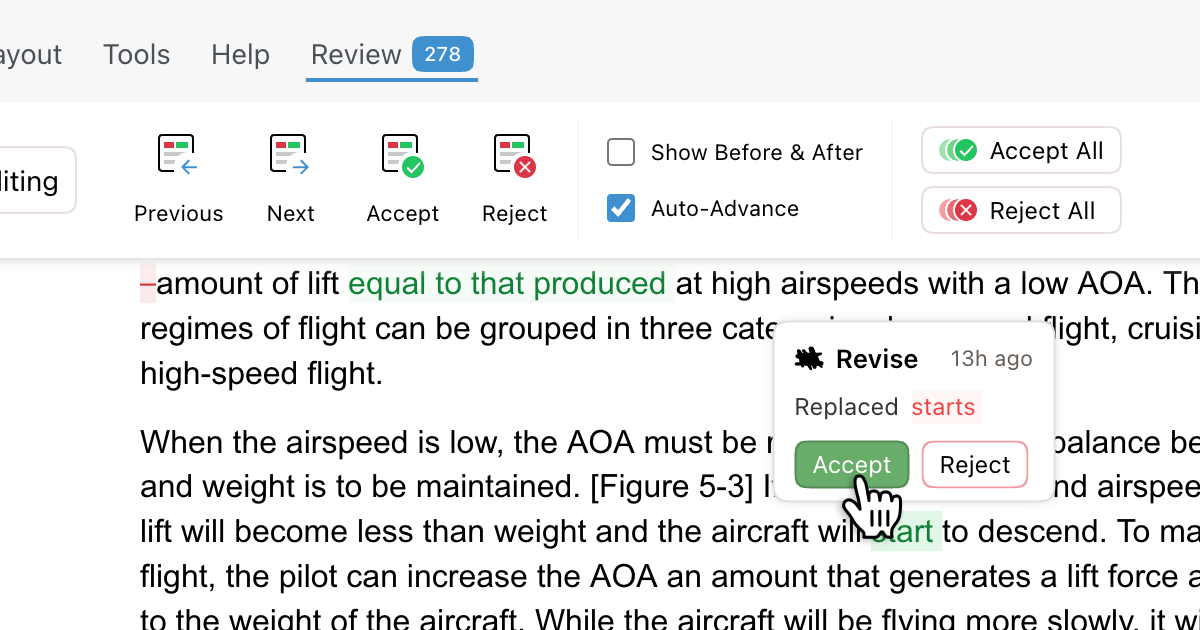
Revise is a browser word processor with an AI agent built in. You write or import a document, ask for a revision, and the agent works through the wording and formatting of the whole draft. It proposes text and formatting edits as tracked changes that you accept or reject, while header, footer, and page layout changes apply immediately. You can choose a GPT, Claude, Gemini, or Grok model.
It imports .docx and preserves the Word features it documents, including section layouts, headers and footers, and footnotes. Pending AI suggestions export back to Word as tracked changes. The free plan has a daily AI limit, Plus is $8 a month, and the higher-end models need a paid plan.
Pick it if your writing ends up as a document and you want to review the AI’s text and formatting edits one at a time. Skip it if you need the AI inside the Word window itself, or if you want a chat for open-ended brainstorming with no document attached.
2. ChatGPT: Best general-purpose assistant
- Free plan: Yes, 3 uploads/day
- Paid from: $8/mo
- Built-in AI: ChatGPT
ChatGPT handles a broad range of writing jobs, from brainstorming to rewriting. Its Canvas opens a document beside the chat, where you can mark up text and get inline suggestions. Memory carries your preferences between conversations. The ChatGPT for Word add-in is available on every plan, subject to usage limits.
Go costs $8 a month and may include ads, and Plus is $20. In our August 2026 document review test, the ChatGPT app gave thorough, well-cited feedback but returned an edited .docx without tracked changes. On our model-only benchmark, GPT-5.6 Sol with medium reasoning had the highest proofreading fix rate, 96.5%.
Pick it if you want one assistant for many kinds of writing. Skip it if you need an uploaded file returned with its edits as tracked changes, which the ChatGPT app did not do in our test.
3. Claude: Best for co-drafting with explained edits
- Free plan: Yes, Sonnet and Haiku
- Paid from: $20/mo
- Built-in AI: Claude
Claude Docs (beta, Pro and up) is a shared document where Claude drafts, asks clarifying questions, leaves comments explaining its choices, and co-edits with you in real time. Claude can create .docx files on every plan, subject to usage limits, and on Pro the Claude for Word add-in applies edits as native Word revisions when Track Changes is on. Claude lists context of up to 1M tokens, varying by model, and accepts PDF uploads of up to 1,000 pages.
In our review test, Claude asked clarifying questions first. After more than 11 minutes, it returned a .docx with comments and tracked changes. On ErrataBench, Claude Opus 5 with low reasoning fixed 95.7% of errors, and Claude Opus 5.5 with high reasoning had the lowest bad-fix rate of any model above 90%. The free plan runs Sonnet and Haiku, and Pro is $20 a month, or $17 billed annually.
Pick it if you want an AI that explains its edits, or if you want Claude inside Word. Skip it if you want the cheapest paid plan.
4. Gemini: Best low-cost paid plan
- Free plan: Yes, 32K context
- Paid from: $4.99/mo
- Built-in AI: Gemini
Gemini has the cheapest paid plan here, Google AI Plus at $4.99 a month. Its Canvas is on every plan. You can edit in it directly or by prompt, and then turn a draft into slides, a quiz, or an Audio Overview. Responses export to Google Docs. Gemini inside Google Docs and 1M tokens of context start with Google AI Pro at $19.99.
On ErrataBench, Gemini 3.1 Pro with low reasoning fixed 92.1% of errors, which was below the top OpenAI and Anthropic models we tested. In our review test, Gemini in Google Docs needed some nudging, but after that it made its edits as Google Docs suggestions.
Pick it if you want low-cost drafting in Canvas or you want to export to Google Docs. Skip it if you need AI inside Word.
5. Microsoft Copilot: Best inside Word
- Free plan: Yes, limited, no Word
- Paid from: $9.99/mo
- Built-in AI: Copilot
Microsoft Copilot is built into Word, Excel, PowerPoint, and Outlook on Microsoft 365 Personal ($9.99 a month) and higher, with AI credits and feature limits. In Word you select text and ask for a rewrite, then replace it, insert the new version below, or regenerate.
In our review test, Copilot found issues in the contract and presented them as cards in its chat pane, and Word handled the .docx faithfully. Its fixes changed the text directly and were marked with a blue highlight and an undo button instead of tracked changes. Microsoft does not name the models it uses.
Pick it if you already pay for Microsoft 365. Skip it if you want to choose the model.
6. Grammarly: Best for sentence polish
- Free plan: Yes, 100 AI prompts/mo
- Paid from: $12/mo
- Built-in AI: Grammarly AI
Grammarly flags grammar and tone issues as you write and shows inline suggestions that you accept one at a time. It also offers sentence rewrites and AI detection. It works in Word through its desktop app. The free plan includes 100 AI prompts a month, and Pro raises that to 2,000.
In our review test, it focused on grammar and sentence polish. A .docx exported from its document editor came back with the page margins set to zero.
Pick it if you want cleaner sentences in every app where you type. Skip it if you need a structural review of the whole document, or if you need Word files from its own editor to keep their layout.
7. Sudowrite: Best for fiction
- Free plan: No, free trial
- Paid from: $19/mo
- Built-in AI: Sudowrite
Sudowrite is built for novelists. It drafts from a Story Bible and has tools such as Write, Rewrite, Expand, and Describe, as well as a chat. It runs its own fiction models, Muse and Ballad, alongside 30+ others including Claude, and it imports and exports .docx.
There is a free trial but no free plan. Hobby & Student costs $10 a month for 225,000 credits, and Feedback needs the Professional plan.
Pick it if you write fiction and want AI help generating scenes. Skip it if you write reports, papers, or business documents.
Which AI fits your writing?
The right tool depends on the kind of writing you are doing and where it will end up. The table below lists common writing jobs and the tool that fits each one.
| The job | Best fit | When ChatGPT is enough |
|---|---|---|
| Revise a finished document and review the text and formatting edits | Revise | You need feedback rather than a tracked revision, or the Word add-in's selection tools are enough. |
| Brainstorm, outline, and draft from scratch | ChatGPT | You do not need a specialized document or fiction workflow. |
| Co-edit a draft with comments explaining each revision | Claude | Inline suggestions in Canvas are enough explanation for you. |
| Draft on the lowest paid budget | Gemini | You already pay for ChatGPT or use its free plan. |
| Get AI help inside Word | Microsoft Copilot | You have Word without Copilot and the ChatGPT for Word add-in covers what you need. |
| Clean up grammar and tone as you type | Grammarly | You proofread in batches rather than as you type. |
| Draft a novel | Sudowrite | You want a general assistant rather than fiction tools. |
Where ChatGPT remains a strong fit
- Range. One assistant can help with brainstorming, research, drafting, and rewriting.
- Word on every plan. The ChatGPT for Word add-in is available even on Free, subject to its usage limits.
- Published model lineup. OpenAI names which models each plan gets, from GPT-5.6 Luna on Free to GPT-6 Astra on Pro.
- Memory. It remembers preferences across conversations.
What each costs
| Tool | Cheapest paid plan | Monthly | Per year | AI on that plan |
|---|---|---|---|---|
| Revise | Plus (or $72/yr billed annually) | $8/mo | $72 | Monthly AI limit, no daily limit. GPT-6 Sol, GPT-6 Astra, and Claude Opus 5.5 need Pro |
| ChatGPT | ChatGPT Go (monthly billing, may include ads) | $8/mo | $96 | More messages, uploads, and memory than Free |
| Claude | Claude Pro (or $17/mo billed annually) | $20/mo | $200 | More usage, Opus models, Claude Docs (beta), and Claude in Microsoft 365 |
| Gemini | Google AI Plus (per month) | $4.99/mo | $59.88 | 2x Free usage and 128K context, Gemini in Docs and 1M context start with AI Pro ($19.99/mo) |
| Microsoft Copilot | Microsoft 365 Personal (or $99.99/year) | $9.99/mo | $99.99 | Copilot in Word, Excel, PowerPoint, and Outlook with AI credits and feature limits |
| Grammarly | Pro (billed annually, $30 month to month) | $12/mo | $144 | 2,000 AI prompts a month |
| Sudowrite | Hobby & Student (225,000 credits/month, annual billing is $120/year ($10/month equivalent)) | $19/mo | $120 | 225,000 credits a month, Feedback needs Professional |
How to move a draft between tools
A draft may start in a chat and finish in a document. Whichever tools you use, these steps help:
- Keep the original file untouched and work on a copy.
- Move text in the format that loses the least. Use
.docxfor Word layouts, and paste plain prose. - Check headings, lists, footnotes, and page setup after the move.
- Turn on tracked changes or suggestions wherever the tool offers them before asking the AI to edit.
The bottom line
For drafting from a blank page, ChatGPT and Claude are the general-purpose options. Gemini has the cheapest paid plan, and Copilot is the option built into Word. If you want whole-document text and formatting edits you can review one by one, Revise is the strongest fit on this list. It is a separate browser editor rather than a Word add-in, its higher-end models need a paid plan, and its free plan has a daily AI limit.
Sources
Prices and plan details were checked against each vendor’s own pages on October 4, 2026. Prices are in US dollars as each vendor lists them, and some include local tax. Vendors change plans often, so confirm on the linked page before you buy.
- Revise: Pricing, Supported models, Agent capabilities, Word compatibility, Import and export, MCP server, Suggesting mode, AI usage limits
- ChatGPT: Pricing, Free tier FAQ, File uploads FAQ, Writing blocks, ChatGPT for Word, Capabilities overview, ChatGPT for Word, Creating documents with ChatGPT Work, Google Drive app, Google app data controls, Supported file types, ChatGPT for Google Sheets
- Claude: Pricing, Upload files, Create and edit files, Claude Docs, Claude for Word, Custom connectors
- Gemini: Plans, Limits and upgrades, Canvas, Upload files, Export responses, October 2026 model access changes
- Microsoft Copilot: Pricing for individuals, Revise's AI review test, Edit and rewrite in Word, Copilot Pages, Supported file formats, Choosing a model in Copilot in Word, Copilot licenses, Copilot business pricing, Copilot enterprise pricing, Anthropic models in Copilot (admin controls), Anthropic models in Copilot apps, Copilot button in Word, Missing Copilot button, Turn off Copilot, AI credits, File upload in Copilot, Copilot in Word on mobile, Long documents
- Grammarly: Usage and document limits, Languages, Desktop app, Browser extension, Grammarly Docs, Plans, Grammarly for Word
- Sudowrite: Pricing, Plan prices and billing, Sudowrite, Exporting files, Importing files