Revise Blog - Building a post-AI word processor
The best novel writing software in 2026
Eight book writing apps compared on how they organize a long draft, what they export, how you work with others, and what they cost
 Artur Sapek, Founder of Revise11 min read
Writers often add dedicated software when a book needs more than one long file. They might want scene cards, a story bible, research beside the draft, or an ebook and print interior at the end. Each app below handles a different part of that, so the right one depends on which part of the book is giving you trouble.
I have spent the past year building a word processor that has to stay fast and accurate on book-length documents, so I pay close attention to how these tools handle long manuscripts and Word files. The prices and features here come from each vendor’s own pages, which are linked throughout and listed in the sources at the end.
Novel writing software at a glance
Some of these apps charge once, some charge a subscription, and some have free tiers or lifetime options. Some advertise no AI at all, and for others AI is the main part of the product.
| Tool | Best for | Free plan | Paid from | AI capabilities |
|---|---|---|---|---|
| Scrivener | Organizing and compiling a long manuscript | No (30-day trial on Mac and Windows, counted in days of use) | $59.99 one-time (Scrivener 3 for macOS or Windows) | No AI features on the vendor's pages |
| Reedsy Studio | Free writing and book formatting in the browser | Yes (writing, formatting, PDF and EPUB export) | $4.99/mo (Craft add-on) | No AI features on the vendor's pages |
| Novelcrafter | A story codex, with optional AI on your own model | No (21-day trial, all features) | $4/mo (Scribe) | Scene beats to prose, summaries, character extraction, and chat |
| Dabble | Plotting and co-writing online | No (14-day trial, no card required) | $19/mo (Writer) | No AI features on the vendor's pages |
| Atticus | Writing and formatting on any computer | No (30-day money-back guarantee) | $147 one-time (Atticus) | No AI features on the vendor's pages |
| Sudowrite | Drafting scenes and chapters with AI | No (free trial, no card required) | $19/mo (Hobby & Student) | Story Bible drafting, Write, Rewrite, Expand, Describe, and chat |
| Revise | Revising a draft with AI edits you review as tracked changes | Yes (daily AI limit) | $8/mo (Plus) | Agent proposes text and formatting edits as suggestions. Header, footer, and page-layout changes apply directly |
| Plottr | Outlining plots and whole series | No (30-day trial) | $9.99/mo (Plottr) | None built in |
The second table shows whether you write the manuscript in each app, how the app structures a long draft, what finished files it produces, and how you work with others in it.
| Tool | Draft in the app? | Organizing the draft | Ebook and print output | Collaboration |
|---|---|---|---|---|
| Scrivener | Yes | Binder, corkboard, outliner, Scrivenings | Compiles to ePub, Kindle, PDF, and Word | None listed, compile a copy to share |
| Reedsy Studio | Yes | Chapters, plus boards (one on the free plan) | Print-ready PDF and EPUB, free | Comments and tracked changes from co-authors and editors |
| Novelcrafter | Yes | Codex of characters and places, with mention tracking | Exports Word and Markdown | Specialist plan to invite, any paid plan to edit, free to view |
| Dabble | Yes | Plot Grid, story notes, character profiles | Word, Google Docs, HTML, Markdown, but no direct PDF or ePub | Real-time co-authoring, comments and track changes on Author |
| Atticus | Yes | Chapters, volumes, and parts | ePub, PDF, and DOCX, with 17+ chapter templates | None listed |
| Sudowrite | Yes, with AI drafting | Story Bible, from concept to outline to chapters | Exports .docx | - |
| Revise | Yes | One document with headings and a live table of contents | PDF with page layout, but no EPUB | Real-time co-editing, Word tracked changes and comments round-trip |
| Plottr | No, outlines only | Timeline of scene cards and plotlines, across a series | Exports outlines to Word and Scrivener | Real-time on Pro plans |
To try the AI revision workflow described under Revise below, paste a chapter or import a .docx manuscript and ask for an edit. It opens in Revise in your browser, where you can try one AI request without an account. You need a free account to accept a suggested change.
How we evaluated them
We compared each app against a general word processor such as Word or Google Docs, and looked at what it adds for a book-length project. We used these six checks:
- Drafting and structure. Can you write the book in it, split it into scenes and chapters, rearrange them, and see the whole shape of the book?
- Finished files. Can it produce an ebook and a print interior, or only a manuscript?
- Editors and co-authors. Does it have comments, tracked changes, and real-time co-editing?
- Word files. Can you import and export a
.docx? This matters because formatters such as Atticus and Vellum import one. - AI. Does the vendor offer any AI, what does it do, and can you review what it changed?
- Cost over a long project. Is it a one-time price or a subscription, and what does a year cost?
The ranking gives the most weight to drafting, structure, and finished output, because this comparison is about software that carries a book from first draft to finished file. Tools that cover one narrower stage, such as AI revision or outlining, rank lower even when they are the best at that stage. The table further down sorts the apps by job instead.
The 8 best novel writing apps
1. Scrivener: Best for organizing a long manuscript
- Free plan: No, 30-day trial
- Paid from: $59.99 one-time
- Built-in AI: None advertised
Scrivener organizes a book in a binder. You write each scene or chapter as its own document in a binder, rearrange them on a corkboard of index cards or in an outliner, and read or edit any selection as one continuous text in Scrivenings mode. It also has labels, status, keywords, snapshots before a rewrite, and word targets with a writing history.
When the draft is done, Compile turns it into Word, PDF, ePub, Kindle, Final Draft, or plain text. Its pages list no AI and no real-time co-editing. It is a one-time purchase of $59.99 per platform for Mac or Windows (iOS is $23.99). The 30-day trial counts only the days you use it, and major upgrades are paid.
Pick it if your book has many moving parts and you want notes, research, and draft in one project. Skip it if you want to co-write in real time or need it on Android or the web.
2. Reedsy Studio: Best free book writing software
- Free plan: Yes, writing and formatting
- Paid from: $4.99/mo
- Built-in AI: None advertised
Reedsy Studio is a browser-based book editor that is free for writing and formatting. The free plan includes the editor, one writing goal, 30 days of history, manuscript import, and export to print-ready PDF and EPUB. Co-authors and editors can leave comments and tracked changes. Reedsy says it will never use your writing to train AI.
There are two optional add-ons. Craft ($4.99 a month) adds unlimited history and more stats, and Outline ($7.99 a month) adds unlimited planning boards and templates. It runs only in a browser and has no offline mode.
Pick it if you want to write and typeset a book without paying. Skip it if you need to work offline.
3. Novelcrafter: Best for keeping track of a complex story
- Free plan: No, 21-day trial
- Paid from: $4/mo
- Built-in AI: Connect your own AI (OpenRouter, OpenAI, Claude, local)
Novelcrafter is a browser-based novel writing app built around a Codex. The Codex is a wiki for your book’s characters, places, aliases, relations, and progressions, and it tracks every mention of them in the text. It imports and exports Word files and Markdown.
AI is optional. Novelcrafter provides no model of its own, but from the Hobbyist plan ($8 a month) you can connect a provider such as OpenRouter, OpenAI, or Anthropic, or a local model. The provider bills you separately for what you use. It can then turn scene beats into prose and summarize scenes. The $4 Scribe plan has no AI integration.
Pick it if your book has a large cast or world to keep straight. Skip it if you need a desktop app or ebook formatting.
4. Dabble: Best for plotting and co-writing online
- Free plan: No, 14-day trial
- Paid from: $19/mo
- Built-in AI: None advertised
Dabble is an online novel writing app with a Plot Grid, story notes with character profiles, daily word-count goals, and real-time co-authoring. It runs in a browser and on desktop, iOS, and Android. The Author plan ($29 a month) adds comments, track changes, and sticky notes.
It exports to Word, Google Docs, HTML, and Markdown, but not directly to PDF or ePub, so you format the book elsewhere. Its pages advertise no AI. Plans start at $19 a month, with 20% off annual billing and a $699 lifetime option.
Pick it if you co-write, or want plotting and drafting in one app on every device. Skip it if the subscription or lifetime price is more than your project needs.
5. Atticus: Best for writing and formatting on any computer
- Free plan: No, 30-day refund
- Paid from: $147 one-time
- Built-in AI: None advertised
Atticus combines a chapter-based writing app with a book formatter. It runs on Windows, Mac, Linux, and Chromebook, and in a browser, and works offline. For formatting, it has 17+ chapter templates, a theme builder, a device previewer, footnotes, and large print, and it exports to ePub, PDF, and DOCX. It costs $147 once, with lifetime updates and a 30-day money-back guarantee.
On a Mac, Vellum is a Mac alternative focused on book formatting. It has a text editor you can write in, or you can import a .docx, pick a book style, and generate EPUB ($199.99 once) or EPUB and print PDF ($249.99).
Pick it if you self-publish and want one app for the draft and the formatted book. Skip it if a publisher handles formatting.
6. Sudowrite: Best for drafting with AI
- Free plan: No, free trial
- Paid from: $19/mo
- Built-in AI: Sudowrite
Sudowrite is a fiction app built mainly around AI. Its Story Bible takes a book from concept to outline to chapters. The Write, Rewrite, Expand, and Describe tools generate or rework passages with its own fiction models (Muse and Ballad) or 30+ others including Claude. The Feedback tool, on Professional plans and up, gives developmental and line edits. It imports and exports .docx and says it does not train on your writing.
Plans are metered in credits and start at $19 a month for 225,000, or $120 a year ($10 a month equivalent).
Pick it if you want AI to help generate the draft. Skip it if you want AI kept out of your prose.
7. Revise: Best for revising a draft with AI
- Free plan: Yes, daily AI limit
- Paid from: $8/mo
- Built-in AI: Revise Agent
Revise is a browser word processor built around an AI agent, and it is most useful at the revision stage. A book is one document organized by headings, with a live table of contents, footnotes, and per-section page layout. There is no binder, corkboard, or story bible, and it exports PDF but not EPUB. It runs only in a browser and has no offline mode.
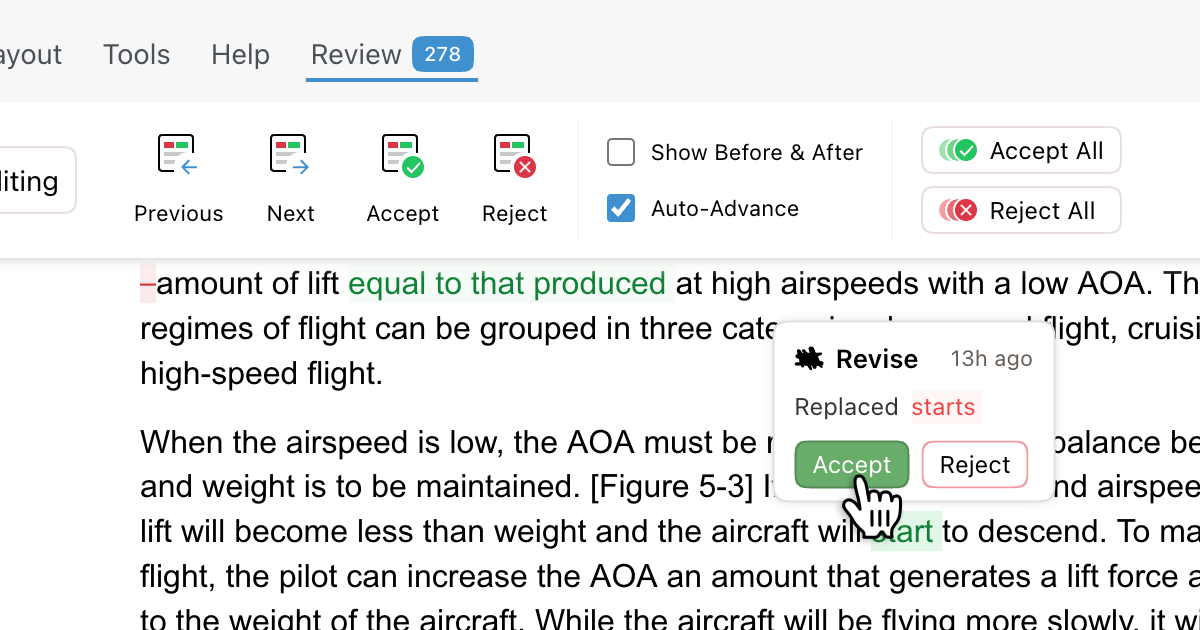
The agent reads the manuscript and proposes text and formatting edits as tracked changes that you accept or reject one at a time. Header, footer, and page layout changes are applied directly. The free plan has a daily AI limit, and larger Claude, GPT, Gemini, and Grok models need a paid plan. An editor can work in the same document in real time or as a suggester.
It is a separate editor, not a Word add-in. Word manuscripts import with their tracked changes and comments, and pending suggestions export back as Word tracked changes, for the Word features it documents. Pick it if you have a draft and want AI edits you can review one by one. Skip it if you are still plotting, need ebook files, or need to work offline.
8. Plottr: Best for outlining plots and series
- Free plan: No, 30-day trial
- Paid from: $9.99/mo
- Built-in AI: None
Plottr is a visual outliner. You put scene cards on a timeline with one row per plotline, and you can plan a series across unlimited books using 30+ templates such as the Hero’s Journey and Three Act structure. It exports outlines to Word and Scrivener, so you draft somewhere else. Its pricing page says it has no AI.
It costs $9.99 a month, $60 a year, or $150 for a lifetime license. Pro plans add the web app and real-time collaboration.
Pick it if you plan before you write, especially across a series. Skip it if you want one app for outlining and drafting.
Which app fits your stage of the book?
| What you need | Best fit | When Word or Google Docs is enough |
|---|---|---|
| Keep scenes, notes, and research in one project | Scrivener | Heading styles and a navigation pane give you enough structure. |
| Write and typeset a book for free | Reedsy Studio | You only need a manuscript file, not an ebook or print interior. |
| Track a large cast and world | Novelcrafter | A separate notes document keeps up with your story. |
| Co-write a novel in real time | Dabble | A shared Google Doc or Word file works for your co-author. |
| Format ebook and print yourself | Atticus, or Vellum on a Mac | A publisher or designer handles formatting. |
| AI that drafts scenes from your outline | Sudowrite | You would rather write every scene yourself. |
| AI edits reviewed one by one across a manuscript | Revise | You prefer Copilot in Word or Gemini in Docs and do not need a separate editor. |
| Plan plotlines across a series | Plottr | A single-book outline fits in a list of headings. |
What Word and Google Docs still do best
A general word processor can carry a novel from first draft to final manuscript.
- Tracked changes in the file you write in. A
.docxwith tracked changes and comments opens natively in Word. - Free browser options. Google Docs and Word for the web cost nothing and run in a browser.
- Sharing and co-editing. Both share a document by link and let several people edit it at the same time.
- Built-in AI on paid plans. Word has Copilot and Docs has Gemini.
For a free desktop option, LibreOffice Writer is open source, works offline, and opens and saves Word files.
What each app costs
Scrivener and Atticus are one-time purchases, so they get cheaper per year the longer you use them, and Dabble and Plottr offer lifetime licenses alongside subscriptions. Reedsy Studio is free without its add-ons, and Revise has a free plan with a daily AI limit. For comparison, Microsoft 365 Personal, which includes desktop Word, is $99.99 a year, and Google Docs is free.
| Tool | Cheapest paid plan | Monthly | Per year | AI on that plan |
|---|---|---|---|---|
| Scrivener | Scrivener 3 for macOS or Windows (per platform, iOS $23.99, Mac + Windows bundle $95.98, major upgrades paid) | $59.99 one-time | - | None |
| Reedsy Studio | Craft add-on (optional add-on, Outline add-on $7.99/mo, annual saves 10%) | $4.99/mo | - | None |
| Novelcrafter | Scribe (billed monthly, annual billing gives 2 months off) | $4/mo | - | None, AI integration starts on Hobbyist ($8/mo) |
| Dabble | Writer (billed monthly, save 20% billed annually, $699 lifetime Author) | $19/mo | - | None |
| Atticus | Atticus (lifetime updates included) | $147 one-time | - | None |
| Sudowrite | Hobby & Student (225,000 credits/month, annual billing is $120/year ($10/month equivalent)) | $19/mo | $120 | 225,000 credits a month, Feedback needs Professional |
| Revise | Plus (or $72/yr billed annually) | $8/mo | $72 | Monthly AI limit, no daily limit. GPT-6 Sol, GPT-6 Astra, and Claude Opus 5.5 need Pro |
| Plottr | Plottr (or $60/yr billed annually, $150 lifetime) | $9.99/mo | $60 | None |
Moving a manuscript between apps
A .docx file can serve as a bridge between many of these apps.
- From Word or Google Docs, download a
.docx. Scrivener, Novelcrafter, Sudowrite, Atticus, Vellum, and Revise import it, and Reedsy Studio imports manuscripts in major text formats. - From Scrivener, compile to Word, then import the file into a formatter such as Atticus or Vellum, or into Revise for AI revision.
- From Dabble or Plottr, export to Word, then continue in an app that imports it, such as Scrivener, Novelcrafter, Sudowrite, Atticus, Vellum, or Revise.
- Compare chapter breaks, italics, and scene breaks against the original before you keep writing.
The bottom line
Choose the app that fits the stage your book is at, whether that is structure, story context, co-writing, formatting, or revision.
Sources
Prices and plan details were checked against each vendor’s own pages on October 4, 2026. Prices are in US dollars as each vendor lists them, and some include local tax. Vendors change plans often, so confirm on the linked page before you buy.
- Scrivener: Scrivener overview, Scrivener features, Store, FAQ
- Reedsy Studio: Reedsy Studio, Pricing, FAQ
- Novelcrafter: Pricing, Features, Does Novelcrafter provide its own AI?, Export, Word import
- Dabble: Pricing, Export your manuscript
- Atticus: Atticus, Checkout
- Sudowrite: Pricing, Plan prices and billing, Sudowrite, Exporting files, Importing files
- Revise: Pricing, Supported models, Agent capabilities, Word compatibility, Import and export, MCP server, Suggesting mode, AI usage limits
- Plottr: Pricing, Features
- Vellum: Vellum, Vellum Press, Importing
- Microsoft Word: AI capabilities and access, Previous versions, Track Changes, Navigation pane, Real-time co-authoring, Save as PDF, Compare documents (legal blackline), Microsoft 365 plans, Word for the web, Revise's AI review test, Copilot in Word, Track Changes in Word for the web, Word options: General, Print a document, Office for the web in OneDrive, Microsoft 365 mobile apps, Removed Windows features (WordPad), Word for the web service description, Similarity checking, Editing with Copilot and Track Changes (Microsoft 365 Copilot), Copilot and document length, When you need a Microsoft 365 subscription
- Google Docs: Edit Office files, Version history, Suggest edits, Workspace pricing, Google AI plans, Gemini in Docs, Gemini features by plan, Gemini usage limits in Google apps, Edit Office files in Google Drive
- LibreOffice Writer: Writer guide: advanced text, Writer guide, LibreOffice 26.8 release, Download, Track changes, LibreOffice, System requirements, Using Microsoft Office files