Revise Blog - Building a post-AI word processor
Google Docs vs Microsoft Word
A comparison of collaboration, Word files, built-in AI, and price, based on each vendor’s current plans and our contract-review test
 Artur Sapek, Founder of Revise7 min read
This comparison is for anyone choosing between the two for their own work, or for a team choosing between Google Workspace and Microsoft 365. Both are capable word processors, so the differences that matter are how you share documents, whether your files have to stay in Word’s format, and what the built-in AI costs and does.
I have spent the past year building Revise, a word processor that opens and saves Word files, and we ran both editors’ AI on the same contract. Plans and prices come from each vendor’s own pages, which are linked in the sources at the end.
Google Docs vs Word at a glance
| Google Docs | Microsoft Word | |
|---|---|---|
| Free plan | Yes (with a Google account) | Yes (Word for the web) |
| Paid from | $7/mo per user, annual plan (Workspace Business Starter, without Gemini in Docs) | $9.99/mo (Microsoft 365 Personal, Copilot with usage limits) |
| Platforms | Web, iOS, Android | Web, Windows, Mac, iOS, Android |
| Real-time co-editing | Yes | Yes |
| Word files | Yes (edits .docx directly, imports and exports) | Yes (native format) |
| Built-in AI | Gemini | Copilot |
| AI capabilities | Gemini drafts, rewrites, and summarizes, refinements you accept or reject | Copilot drafts, rewrites, and summarizes, edits in place with highlight and undo |
| AI edits in our test | Comments under the user's name and Docs suggestions, after extra prompting | Changed text directly, with highlight and undo, when asked to fix an issue |
To try Revise on your own document, paste from Google Docs or import a Word file below. It opens in your browser, and you don’t need an account.
Key differences
At the end of each difference, we say which one has the edge for that job.
Collaboration
Both support real-time co-editing and comments. Google Docs builds the workflow around Google Drive in the browser, and Word builds it around Microsoft 365 on the web and in its apps.
Edge: a tie, so choose the ecosystem your collaborators already use.
Suggestions, tracked changes, and history
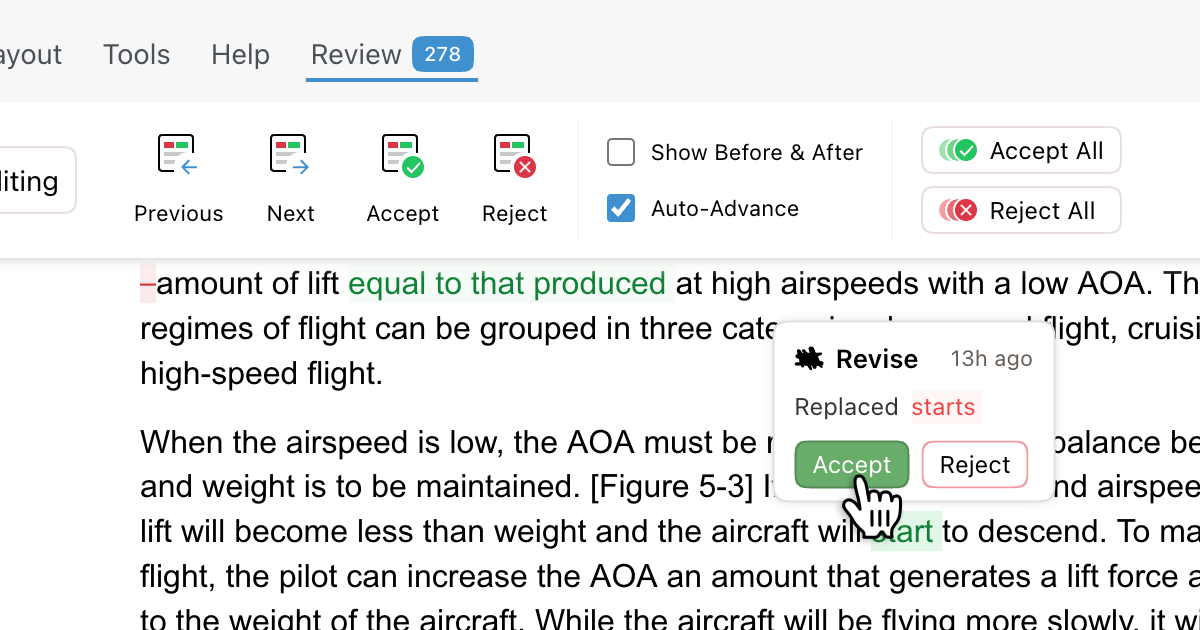
Google Docs has suggested edits, which show changes in a new color and cross out deletions, and the owner accepts or rejects each one or all at once. Google says tracked changes from Microsoft Office files become suggestions, and suggestions become tracked changes in Office files. Its version history shows who changed a file and lets editors restore or name versions. Word keeps previous versions of files stored in OneDrive or SharePoint, and has Track Changes on the desktop, the web, iPhone, and iPad. Track Changes underlines additions and strikes through deletions, and reviewers accept or reject changes one at a time or all together.
Edge: a tie, because both have mature review tools and Docs converts Word’s tracked changes into its own suggestions.
Word files
.docx is Word’s native format, and in our test Word handled the test contract and exported it with its formatting intact. Google Docs can edit Office files directly, with changes saved in the original Office format, or convert them to Google’s format. We did not run a controlled formatting round trip through Docs, so check complex files in Word before you send them.
Edge: Word, because .docx is its own format and we tested how it handles one. Docs can also edit .docx in place.
Built-in AI
Word’s AI is Copilot, which is included in Microsoft 365 Personal (and for the subscription owner on Family) with usage limits and runs on models Microsoft selects. In our contract-review test, Copilot found issues and listed them as cards in its chat panel rather than as margin comments. When we asked it to fix one, it changed the text directly and marked the change with a blue highlight and an undo button.
Gemini in Docs needs Workspace Business Standard or, for individuals, Google AI Pro. In the same test, Gemini first answered with a long chat reply. After some nudging, it left comments in the document under the user’s own name and made edits as Docs suggestions that you accept or reject.
Edge: Word on list price, because Microsoft 365 Personal ($9.99 a month) costs less than Google AI Pro ($19.99). The bundles include different products, though, and Copilot has usage limits. In our one contract test, Gemini presented edits as Docs suggestions, while Copilot rewrote the text in place with a highlight and undo.
Platforms and apps
Google Docs runs in the browser and has apps for iOS and Android. Word runs on the web and has apps for Windows, Mac, iOS, and Android, including desktop apps on Windows and Mac.
Edge: Word, if you want a full desktop app. Otherwise it is a tie.
Which should you choose?
Choose Google Docs if
- your team or school already uses Google accounts
- you write in the browser and share by link
- you want AI edits as suggestions and have a plan with Gemini
Choose Word if
- you exchange .docx files with clients or colleagues
- you want full desktop apps on Windows or Mac
- you want AI included in a $9.99 personal plan
Where Revise fits
Revise, which we build, is a separate browser word processor that opens and saves .docx. Its AI agent runs GPT, Claude, Gemini, and Grok models and proposes text and formatting edits as tracked changes that you accept or reject. Content pasted from Google Docs keeps its formatting, but there is no direct Google Drive import, and its higher-end models need a paid plan.
What each costs
Both editors are free in a browser. The table compares the individual plans that add each product’s own AI, and the bundles differ in what else they include.
| Tool | Free | Individual plan with in-editor AI |
|---|---|---|
| Google Docs | Google Docs with a Google account, without Gemini | Google AI Pro, $19.99/mo |
| Microsoft Word | Word for the web with a Microsoft account, without Copilot | Microsoft 365 Personal, $9.99/mo or $99.99/yr (Copilot with usage limits) |
The bottom line
In most cases you should pick the one your collaborators already use. If nobody has decided yet, Google Docs fits teams that already work in Drive, and Word fits teams that deliver .docx files and want desktop apps.
For more options, see Google Docs alternatives and Microsoft Word alternatives.
Sources
Prices and plan details were checked against each vendor’s own pages on October 4, 2026. Prices are in US dollars as each vendor lists them, and some include local tax. Vendors change plans often, so confirm on the linked page before you buy.
- Google Docs: Edit Office files, Version history, Suggest edits, Workspace pricing, Google AI plans, Gemini in Docs, Gemini features by plan, Gemini usage limits in Google apps, Edit Office files in Google Drive
- Microsoft Word: AI capabilities and access, Previous versions, Track Changes, Navigation pane, Real-time co-authoring, Save as PDF, Compare documents (legal blackline), Microsoft 365 plans, Word for the web, Revise's AI review test, Copilot in Word, Track Changes in Word for the web, Word options: General, Print a document, Office for the web in OneDrive, Microsoft 365 mobile apps, Removed Windows features (WordPad), Word for the web service description, Similarity checking, Editing with Copilot and Track Changes (Microsoft 365 Copilot), Copilot and document length, When you need a Microsoft 365 subscription
- Revise: Pricing, Supported models, Agent capabilities, Word compatibility, Import and export, MCP server, Suggesting mode, AI usage limits